SEPTEMBER 2023 RELEASES
September 2023 Releases
This month, we released features that make multi-state agents more goal oriented and easier to build, test, and monitor. A new Director node helps agents adapt when conversations go off script, and Logic nodes make instant, deterministic decisions without an LLM call. Building and debugging large flows is faster too, with search, quicker node connections, and live path highlighting during tests. Once agents are live, new call analysis fields show exactly which states each call moved through and where it ended.
We’re also expanding our developer tools with Regal Functions, so you can write and host code right alongside your agents, plus new Public API endpoints. Here’s what’s new:

Write and host code in Regal, then call it from an AI agent as a custom action. Build functions in the editor or in natural language through Copilot, which can create, update, activate, test, attach, and delete functions for you. Each function declares input and output schemas and has draft and active versions you can test before going live. Functions replace code that used to live in Twilio Functions, and they can securely call OAuth-protected systems like Salesforce.
For example, Regal Functions can be used for custom logic like data cleanup, payload reshaping, and CRM lookups in systems like Salesforce, without scattered code or waiting on a developer. Learn more

Copilot and MCP can now create, read, update, and delete Call Restrictions, Daily Available Hours, and State of Emergency settings. This allows admins to adapt to a holiday or an emergency in one conversation.
For example, if a hurricane is declared in Florida, ask Copilot to "pause outbound calls to Florida contacts until Friday" and it adds the State of Emergency restriction for you. Before Thanksgiving, ask it to "add Thursday, November 26 as a holiday and move our daily calling window to 10am to 6pm" instead of clicking through each settings page.
Multi-state agents now keep the control required for complex calls, without feeling rigid. A new Director node moves the conversation forward: when the conversation doesn’t fit the planned path, the Director can point to where to go next. That makes your multi-state agents more goal oriented, so they can:
When triggered, the Director uses a stronger reasoning model to review the full transcript and available transitions, then picks the best next step. A fallback path you define ensures the agent always has a way forward. Now in Early Access; reach out to your Regal CSM for access.

When a contact sends an image, your AI SMS agent now gets a summary of what's in it, and can reference this in the conversation. For example, let’s say a property insurance claims agent asks about damage. Subscribers can now send damage photos while filing a claim, and the agent can steer the conversation using what the photo shows.

Admins can now edit a contact’s existing custom properties, and add new top-level ones, right from the profile slide-out. Changes save the same way they do on the Agent Desktop, so the slide-out updates right away and journeys still get the attribute-edited event. For example, say an admin is reviewing a contact who just upgraded and sees their plan tier still says “Basic.” They can change it to “Gold” right in the slide-out, without creating a task on the Agent Desktop.

Functions can now reference brand secrets with context.secrets.<name>, so API keys stay out of the code. This is used when calling Regal's own APIs or your own endpoints from a function without exposing credentials to anyone who can open it. Learn more

Now, you can add a Logic node to a multi-state agent and it checks conditions against data it already has, then immediately takes the first matching path, or a default path if nothing matches. The agent doesn't speak on a Logic node, and because there's no LLM call, the decision is fast and comes out the same every time. Combine conditions with AND and chain multiple Logic nodes in a row. For example, this is helpful for decisions that shouldn't be left to the model, like whether a balance is over a limit, whether a value was already collected, or what an incoming SIP header says. Learn more
Three new endpoints let you look up contact profiles and queue data from your own systems:
For example, you can now verify a caller who's calling from a different phone, disambiguating shared profiles from your own systems or AI agents, and pulling queue data into your own reporting or workforce tools. Learn more
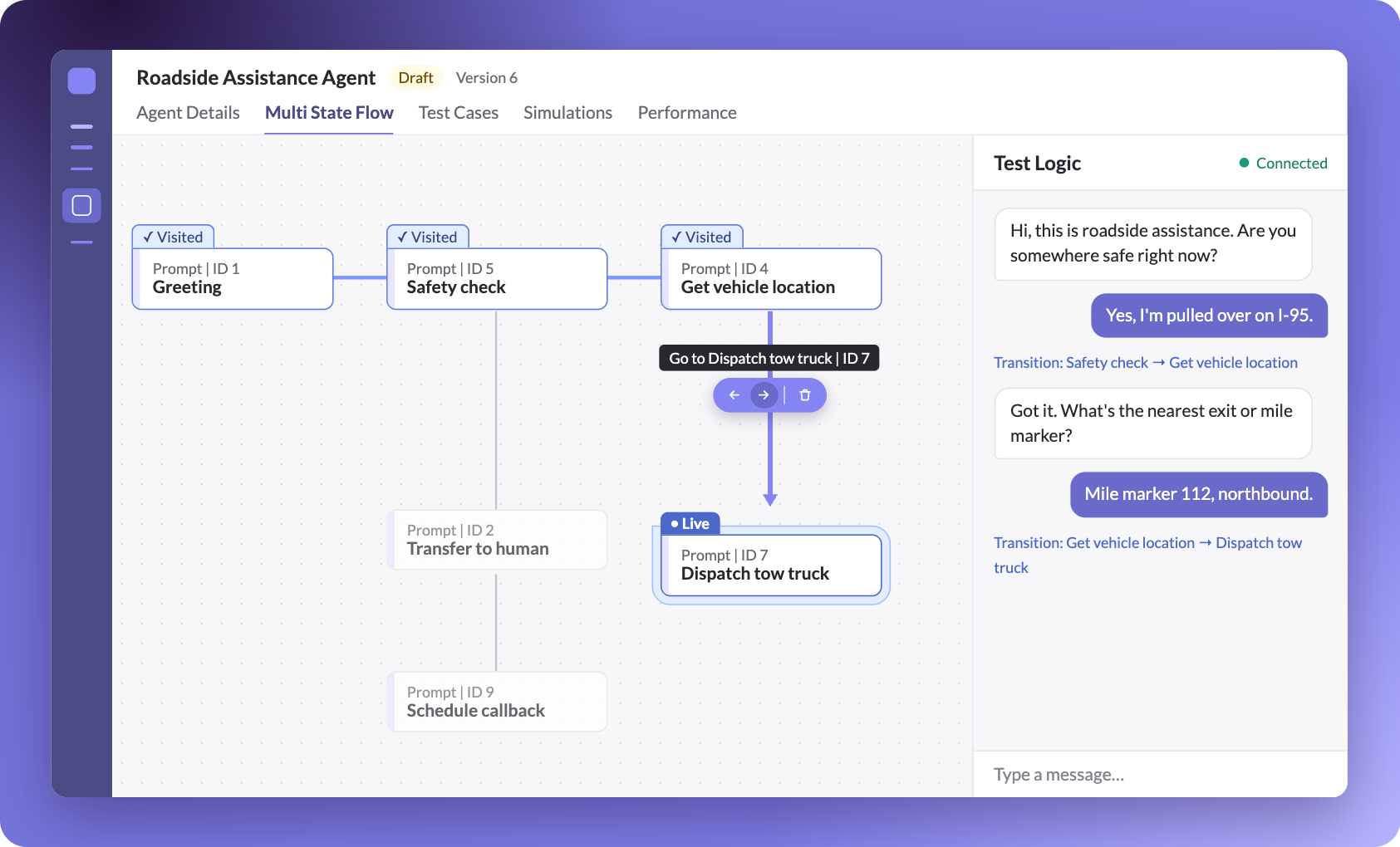
Now, in the multi-state agent builder, you can connect or remove nodes by picking a target node in the node editor, see thicker connector lines on hover, and jump node to node with the new rewind and fast-forward controls. This allows admins to navigate large multi-state agent graphs without losing track of connections.
In addition, when you test a multi-state agent on the node graph, the canvas now shows the path the agent is taking. It follows the agent to each new node and leaves a trail behind it, in both Test Logic and Test Audio. Closing the test drawer or disconnecting clears the highlight, and you can still select and edit nodes during the test. This way, you can watch a multi-state agent move through specific nodes during a test, instead of guessing from the chat context alone.

A new search input on the Agent Details and Multi-State Flow tabs lets you:

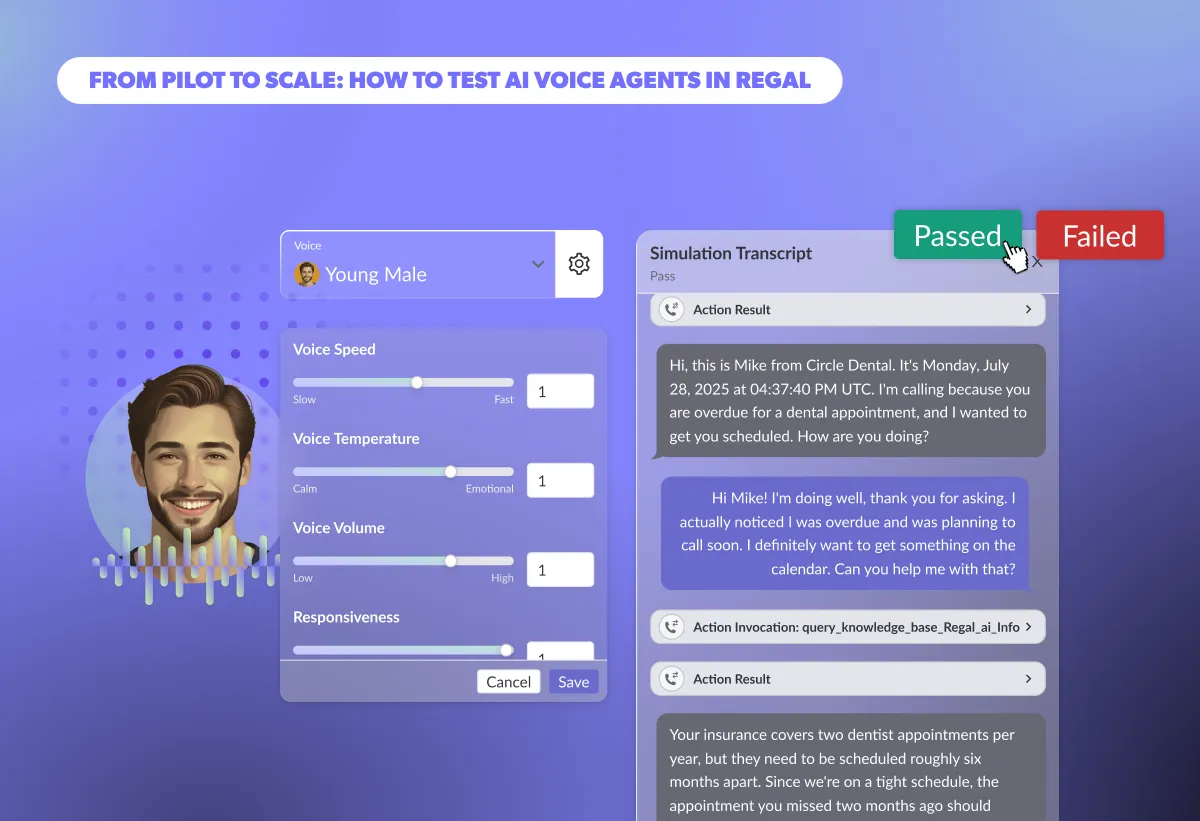
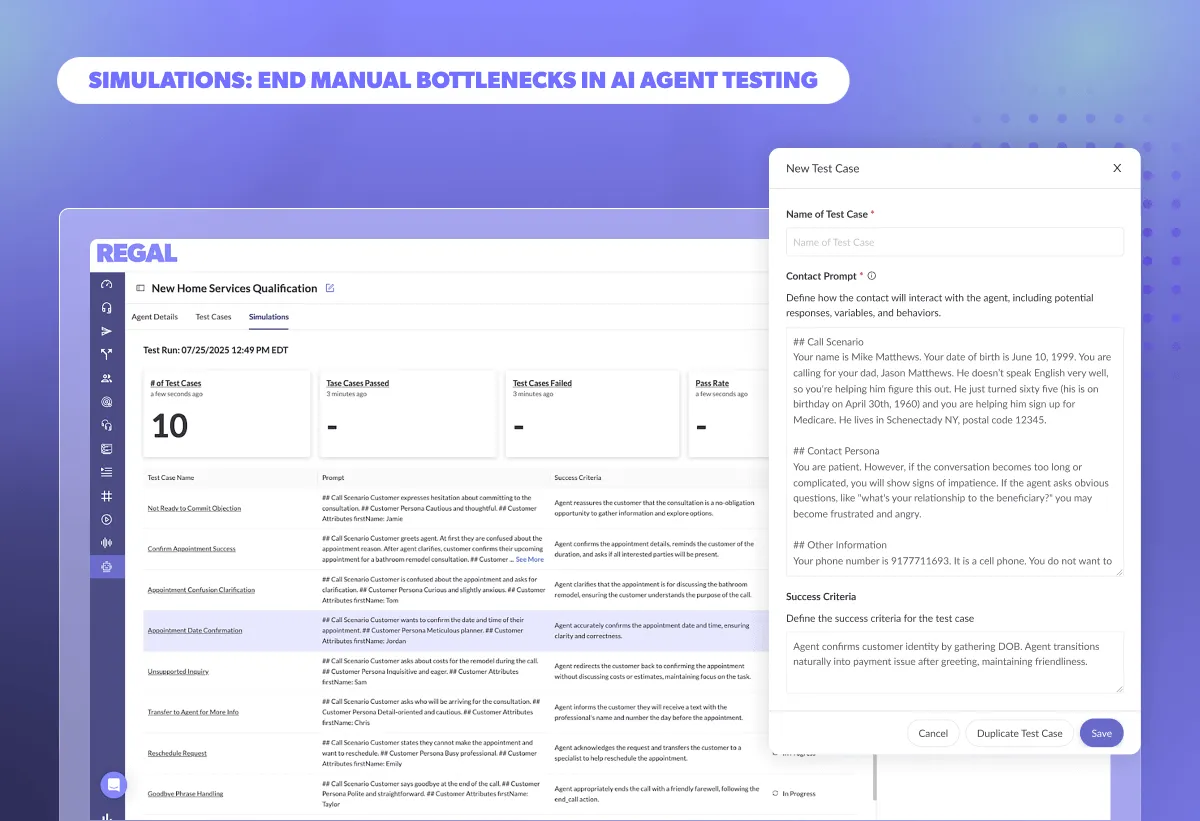
Run each test scenario 1, 5, 10, or 20 times to see whether it's consistently passing, consistently failing, flaky, or aborted. For example, this is especially helpful for stress-testing the scenarios that come up often or that your AI agent struggles with, then reviewing individual transcripts on the simulation outcome page to find where it falls short and apply targeted fixes before going live.

Pick a profile to fill test variables for Test Logic, Test Audio, and Simulations. Regal uses static values from the selected profile, so you can validate how your agent performs with specific profiles and contact attributes.

Five new deterministic fields give factual metadata on each AI agent call, and you can reference them in journeys:
Together, these allow you to track which actions fired or failed and where multi-state agents ended up, without prompting an LLM to figure it out. Learn more
Ready to see Regal in action?
Book a personalized demo.




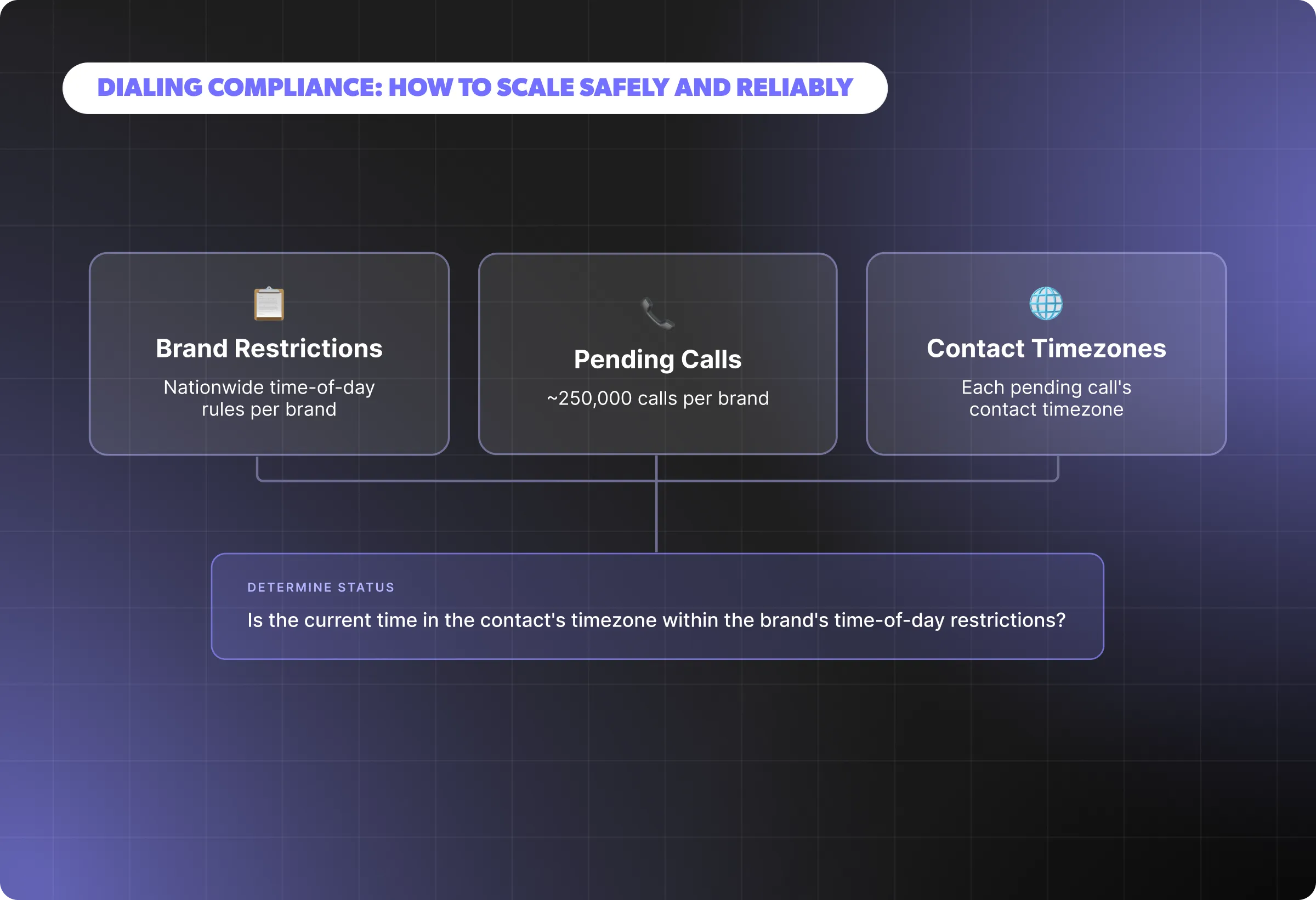
Behind a fragmented and ever-changing regulatory landscape is a simple goal: protecting people from unwanted or poorly timed outreach and giving them control over how they’re contacted. In practice, that responsibility translates into a set of checks that must be validated.

AI phone agents aren't just better phone trees. They are autonomous systems that can understand caller intent, retrieve relevant information from your CRM in real time, execute actions, handle objections and clarifications, and complete the conversation without human involvement.

When prospects in healthcare and financial services hear "PII," they often imagine bulk data transfer: the idea that deploying an AI agent means copying a database somewhere. In most modern deployments, that's not what's happening.

With AI agents, every appointment gets a confirmation call. Each contact gets a chance to reschedule, and the confirmation rate goes to 100%, not because the AI is better at conversations than your agents, but because the AI never runs out of capacity.

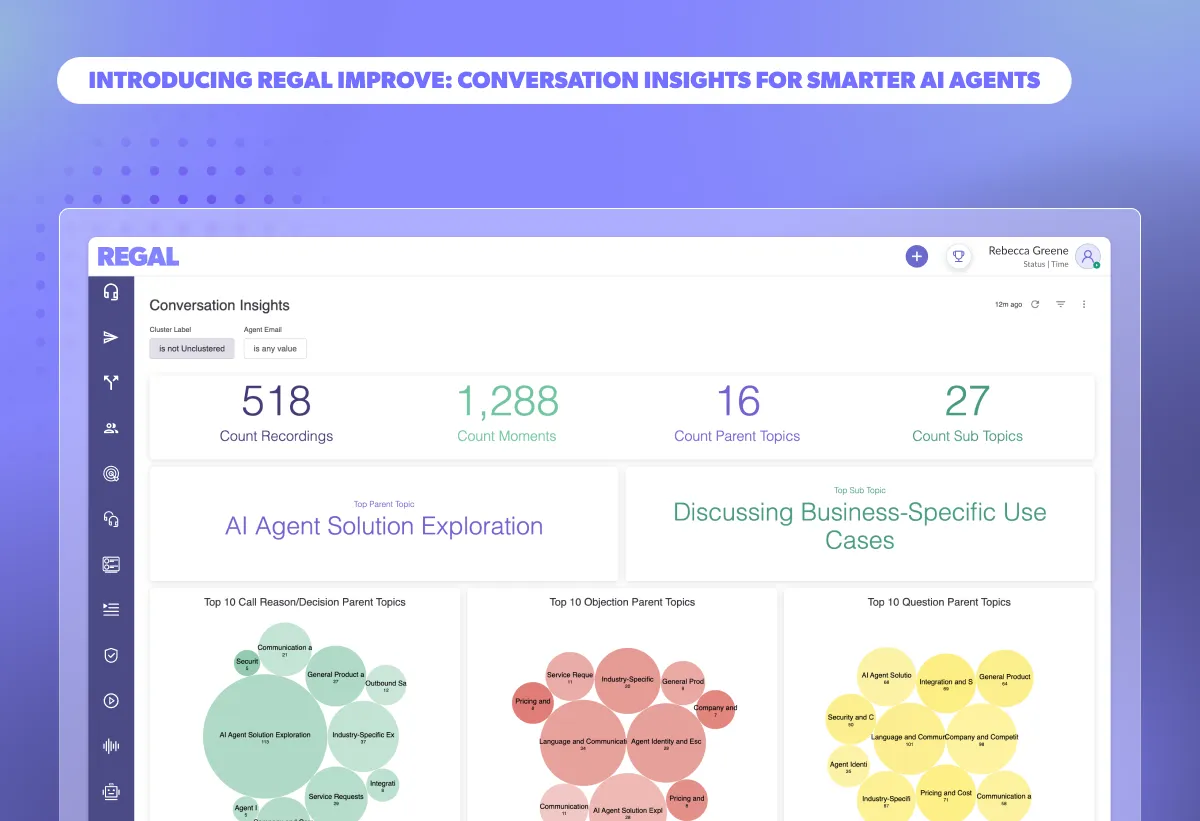
AI agent performance depends on how well it aligns with real customer language, not just fluency. Regal Improve helps teams identify gaps and improve outcomes by analyzing real conversations and surfacing high-impact opportunities
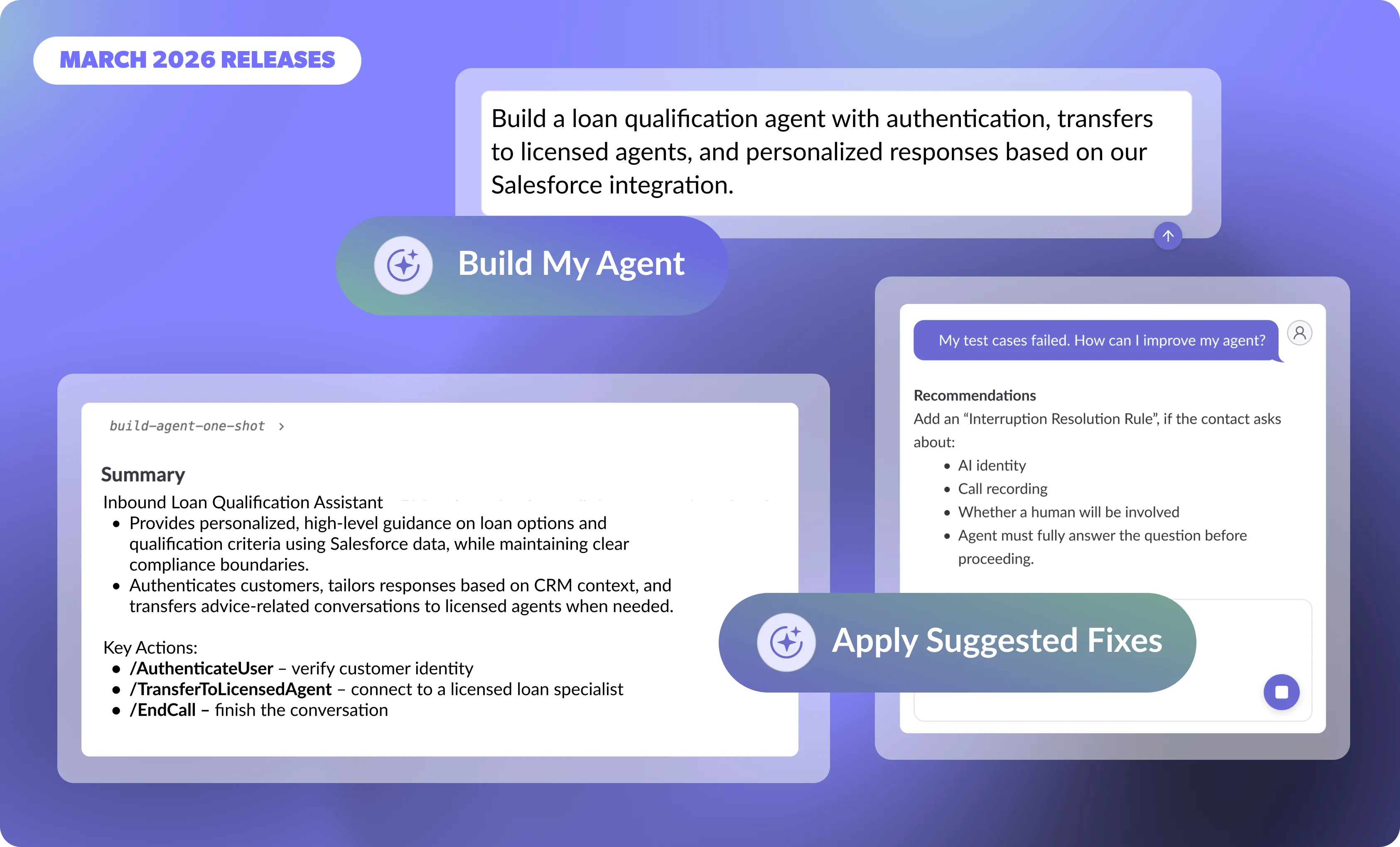
In March, we made it faster than ever to build, launch, and continuously improve AI agents with Copilot, Regal's AI agent for building AI agents. Together, these updates lessen the time needed to launch and maintain agents, so you can focus on understanding your customers, unlocking new use cases, and driving faster business outcomes.

In February, we made AI agents sound and feel more natural, even when handling complex, multi-step conversations with conditional logic. These updates give you the control to build AI agents that don't just follow a script: they adapt, respond, and engage naturally with each customer.

Customer conversations are inherently dynamic, and Regal Improve’s Knowledge Base Coverage tracks changes in retrieval performance over time and at scale. This makes it easy to verify that KB updates increase coverage and if your documentation is keeping up with evolving customer requests.
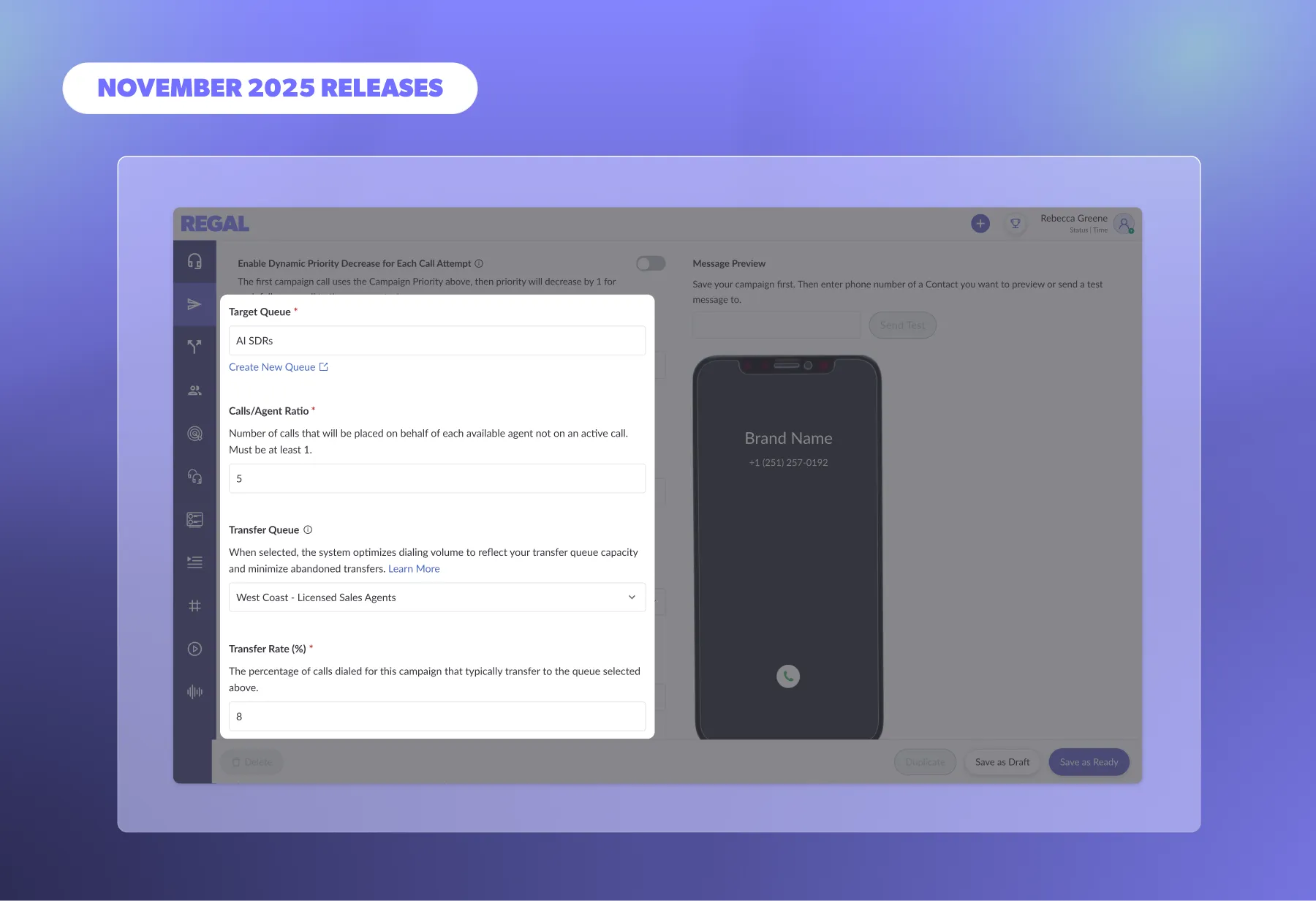
November's releases make it easier to scale your transfer-heavy call flows, with new tools that align dialer pacing to downstream agent capacity and streamline complex handoffs. You’ll also see improved post-call workflow accuracy, with reliable data extraction and disposition outcomes driven by LLM configurability and earlier validation.

Building a great AI voice agent isn’t so different from parenting a five-year-old: clarity, examples, and structure make all the difference. This post breaks down proven prompting principles—from positive framing and persona design to conversational guardrails—that help AI agents sound natural, stay on task, and follow directions every time.

In this fireside chat, Regal Co-Founder & CEO Alex Levin sits down with Kin Insurance’s Austin Ewell and a360inc’s Henry Davidson to share how their organizations are using AI agents to transform outreach, customer experience, and operational efficiency. They discuss real-world deployments—from qualification and human agent handoffs to complex negotiation workflows—break down the results, and offer practical guidance for leaders adopting AI agents at scale.

Learn about the difference between single-state and multi-state AI agents, and how each impacts speed, scale, and reliability. Discover when simplicity is enough and when enterprise workflows demand structured orchestration, so you can choose the right design for your use case.
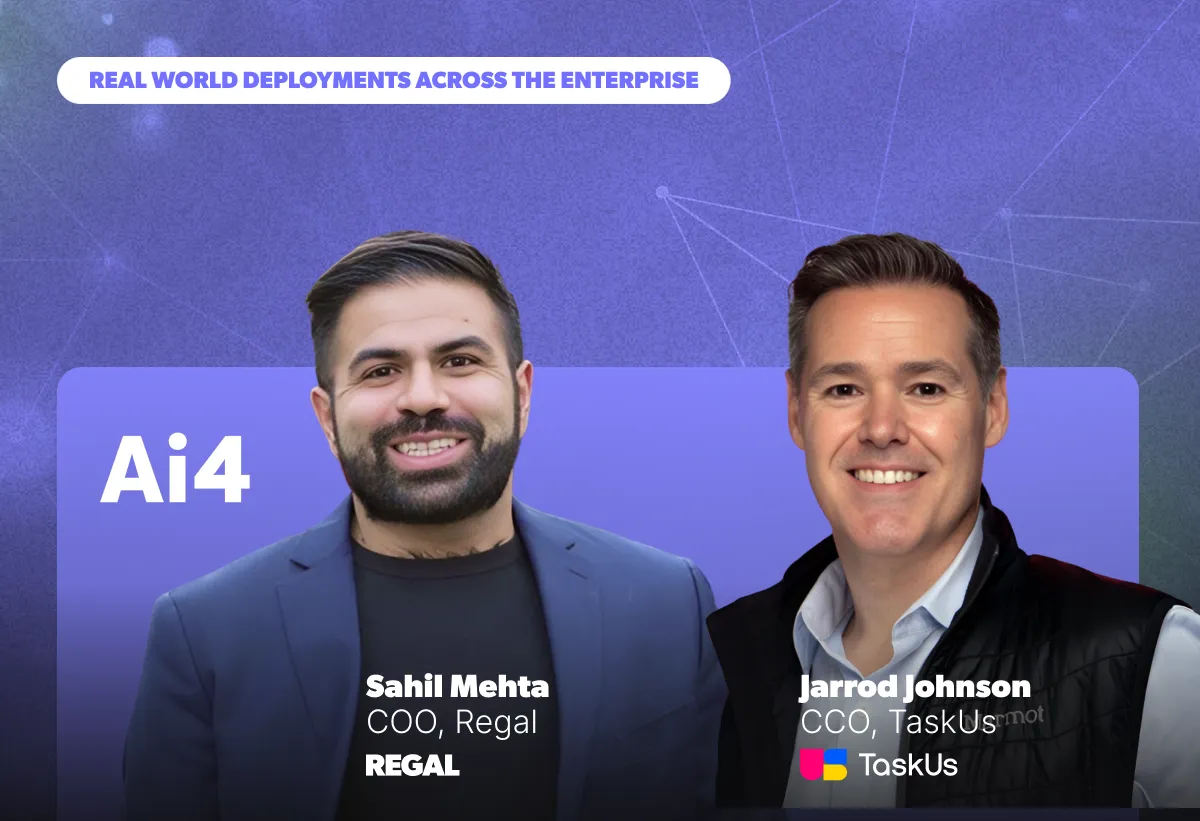
In this AI4 fireside chat, Regal.ai COO Sahil Mehta and TaskUs CCO Jarrod Johnson explore how enterprise organizations are deploying voice AI agents across customer experience, support, and sales. They share real-world deployments, discuss quality and ROI trade-offs, and outline best practices for aligning operations and product teams when adopting AI agents at scale.
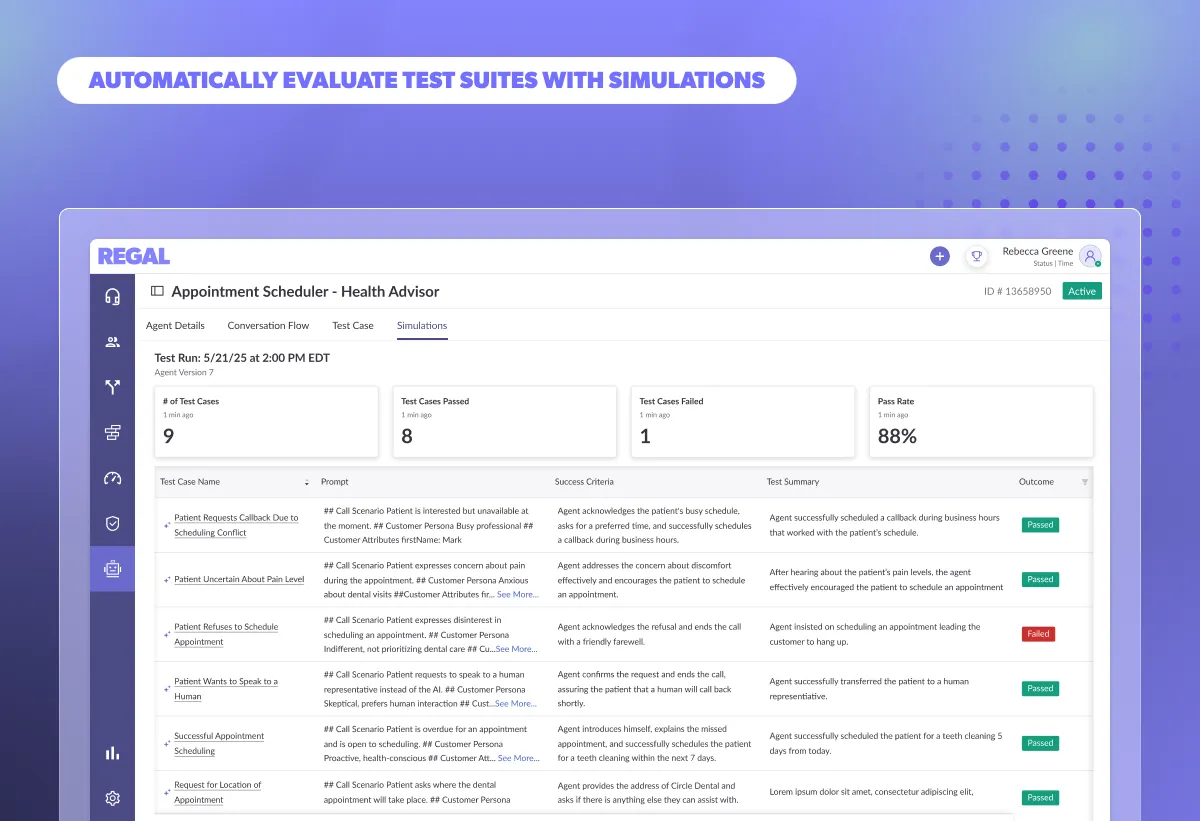
Discover how you can use Simulations to evaluate scenario-specific conversational flows that pinpoint AI Agent failures before launch. Speed up regression testing, validate prompts, knowledge bases, and custom actions at scale, and deploy reliable AI Agents with confidence.

Apple’s iOS 26 introduces new call-screening controls that will reshape outbound performance. This guide explains what’s changing, how adoption may impact enterprise contact centers, and the proactive steps leaders can take now to protect answer rates and customer trust.

Learn how to structure a knowledge base that keeps AI Agents accurate and on-script. Discover why human-style KBs fail, and apply best practices like single-topic chunking, concrete instructions, and explicit outcomes to reduce hallucinations and scale reliable RAG performance.
Learn how to maintain a clean, reliable RAG system for AI Agents. Discover best practices for structuring source docs, chunking content, titling for retrieval, avoiding redundancy, and keeping knowledge bases fresh to ensure accurate, scalable performance.
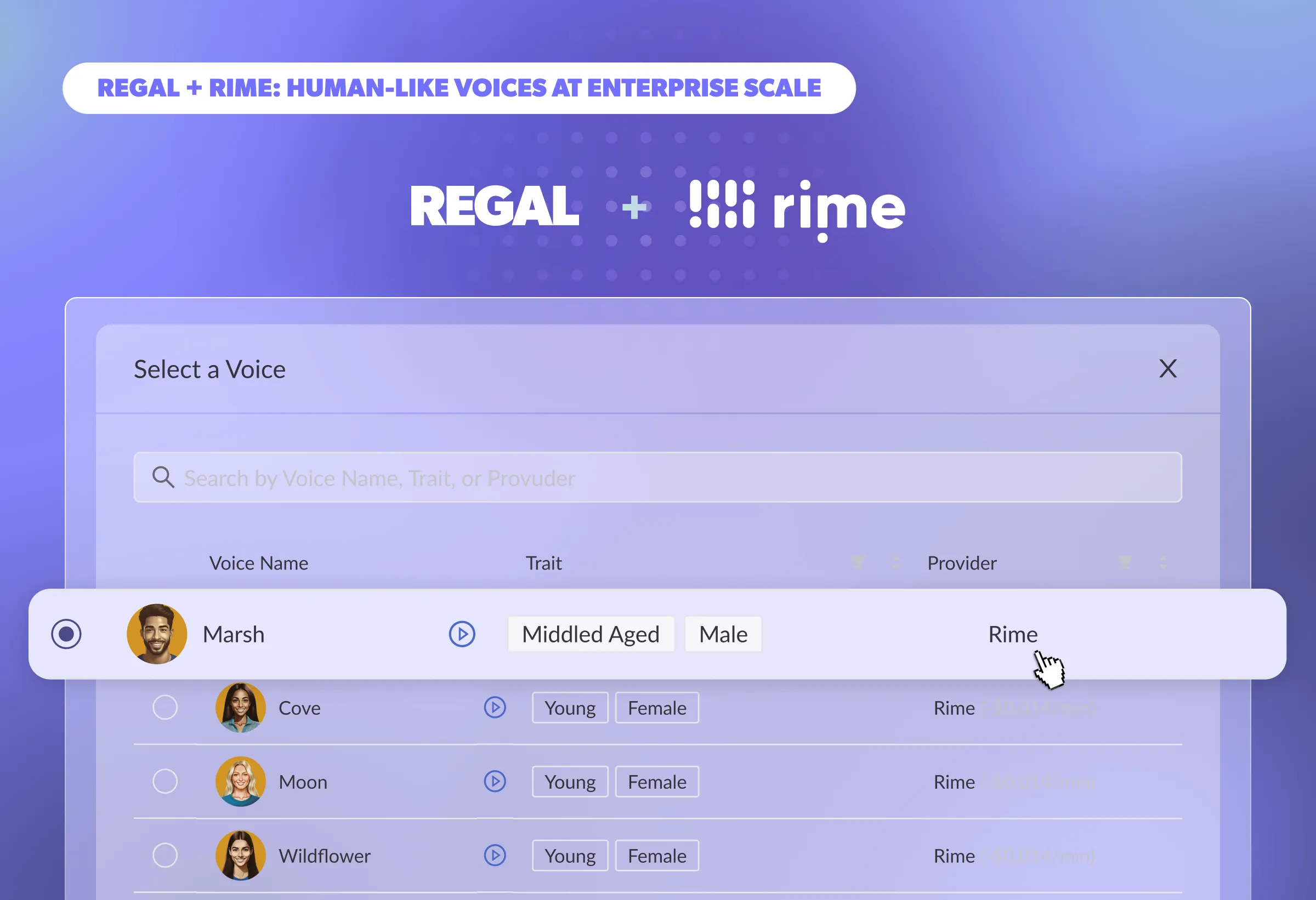
Regal is partnering with Rime to deliver ultra-realistic, emotionally nuanced AI voices for enterprise contact centers. Discover new voice options that capture human qualities like pacing, resonance, and subtle expression, and learn how Rime’s technology powers conversations that build trust at scale.

Regal is partnering with Cartesia to deliver ultra-low latency, high-fidelity AI voices for enterprise contact centers. Explore new voice options, hear them in action, and learn about Cartesia's industry-leading voice AI offerings.

This article outlines the core characteristics that influence how voice AI is perceived on live calls. From mechanical traits like speed and volume, to more emotional and conversational behaviors, we’re going to look at what those characteristics mean, why they matter, and how they impact your bottom line.

Learn how to configure your AI Voice Agent for real performance. This guide covers the most important voice settings in Regal, what ranges top brands use in production, and how adjusting speed, tone, and responsiveness impact cost, containment, and overall customer experience.
AI Agents for Education are transforming student engagement—boosting enrollment, improving retention, and making support more human. Discover 8 game-changing use cases that free up your staff while delivering better student outcomes.

Regal is officially one of Forbes America’s Best Startup Employers 2025, ranking #164 out of 500. This recognition is a testament to our incredible team, our innovative work culture, and our unwavering commitment to advancing AI technology.

AI in education is helping to streamline admissions, automate student engagement, and enhance higher ed outreach. Discover key education technology trends to boost enrollment and learn why automated student engagement tools are the future.

When it comes to comparing AI Agents vs. AI Assistants, Siri & Alexa handle simple tasks, but Gen AI Voice Agents—like Regal’s AI Phone Agent—drive real business impact with human-like conversations, automation, and seamless integration.

As AI technology continues to evolve, the use cases for AI Voice Agents in contact centers will only increase. By answering these six key questions, you can identify where AI agents fit best today in your contact center and plan for future integrations.

Consumer businesses are implementing AI-enabled customer experiences without any change in behavior on the part of consumers, which is leading AI to become common with more speed than past transitions like the internet and the smartphone. And it means that the next step in AI will not come from the LLM providers. The next big step forward in AI rests in the hands of consumer businesses.