SEPTEMBER 2023 RELEASES
September 2023 Releases
Dialing compliance seems like a solved problem (just follow the law!) until you consider how complicated the law is, and how complex automated validation is at scale. At Regal, we power outbound calling for some of the largest brands in the country across all 50 states.
We’ve powered over 500 million calls across highly regulated industries, including insurance, education, and financial services. In these industries, compliance is the foundation of every customer interaction. One misstep can mean regulatory fines, loss of consumer trust, or an enterprise customer walking out the door. That's why we've invested deeply in making compliance seamless, auitable, and scalable.
Behind a fragmented and ever-changing regulatory landscape is a simple goal: protecting people from unwanted or poorly timed outreach and giving them control over how they’re contacted. In practice, that responsibility translates into a set of checks that must be validated before every call:
.webp)
The first two problems have straightforward solutions:
But state telecommunications laws are another story. As we scaled, they introduced a new layer of complexity that required a more flexible approach with greater compliance nuance. We chose to refactor our architecture to meet those demands, and it paid off exceptionally well. In this blog, we’ll discuss how that evolution unfolded and the design decisions that made it possible.
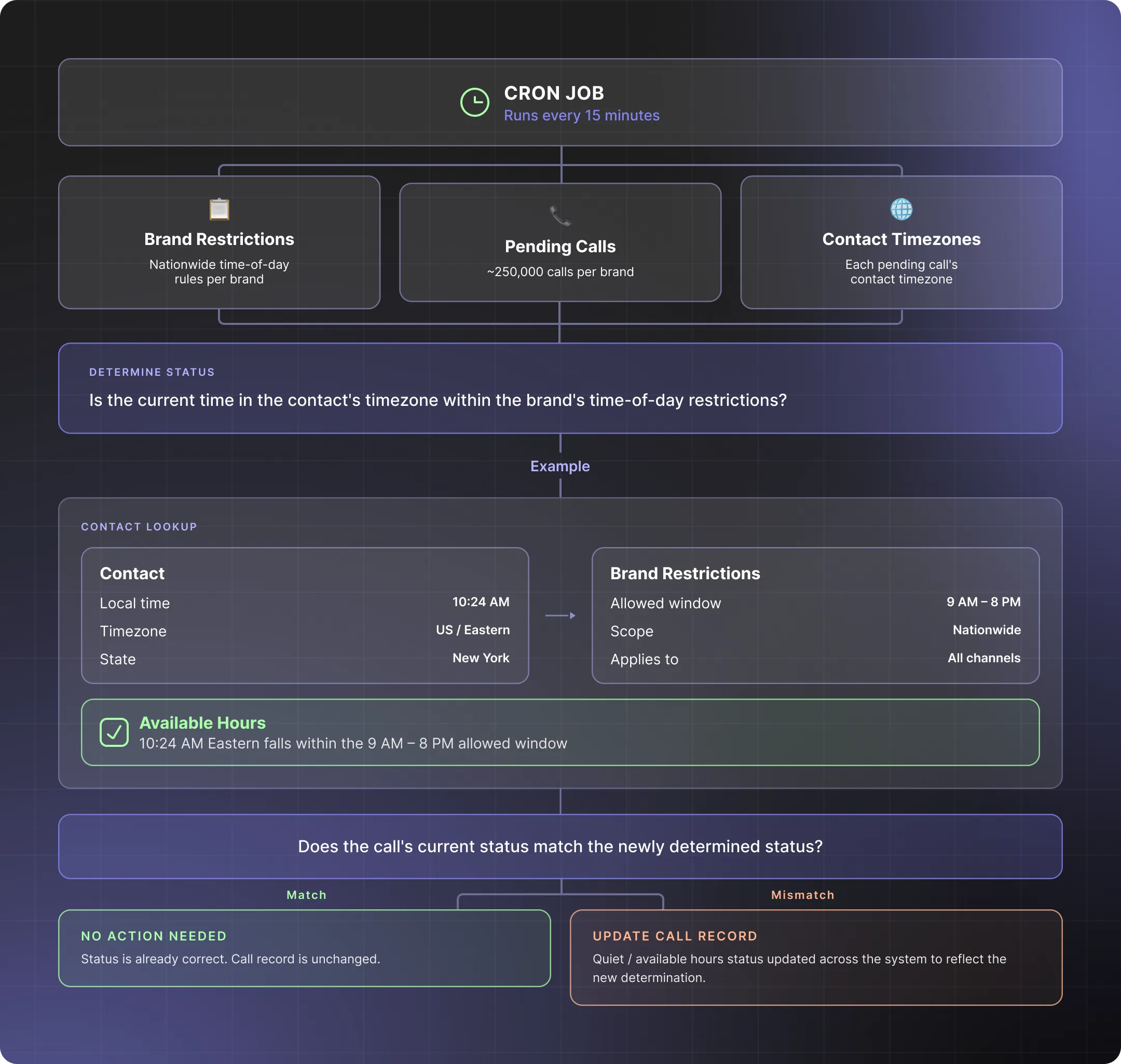
We initially approached regulatory compliance with a centralized, time-based evaluation model. Every 15 minutes, a scheduled cron job would:
We then determined whether calls should be in "quiet hours" or "available hours" based on whether the contact's local timezone fell within the brand's general time-of-day restrictions.
If there was a mismatch between the call's currently configured quiet/available hours status and the newly determined one, we updated that call record and propagated the change throughout our system.
This approach was a deliberate choice for where we were as a company.
It prioritized simplicity and determinism. The cron job was simple, testable, and easy to reason about. For instance, you could write a database integration test that would perfectly simulate all calls moving from quiet to available hours at a specific time.
It also allowed us to defer complexity. With a small number of early customers, we didn't need state-level nuance baked into the system itself. Instead, we handled edge cases like state holidays and per-state calling windows operationally: coordinating agent staffing around restrictions, and using our journey builder to push updates to pending call records when rules changed.
At the scale we were at, performance was not a concern and additional complexity wasn’t required. More importantly, this approach lets us ship a reliable compliance foundation quickly.
As we scaled our dialing volume by 5x and brought on enterprise customers who needed better reliability and automation, the scope of what our compliance system needed to handle expanded significantly.
Performance Considerations: The number of calls fetched and updated grew so large that we got on-call alerts from its impact on our database multiple times a day.
The core query took several minutes to run, and only after it completed would calls begin transitioning into available hours. This led to agents waiting a couple of minutes every morning before they started receiving calls to dial, with the final subset of tasks becoming available up to 30 minutes later.
With scale, this approach became inefficient — a call's dial-ability changed ~2 times a day, but we were recalculating it 360 times a day.
Functionality Expansion: Enterprise customers couldn't rely on staffing adjustments and pieced-together automations to stay compliant. They needed a productized approach to state law compliance that was auditable and turnkey.
We prototyped adding full state-level logic to the existing cron job's query, but the approach became increasingly complex. It grew to 300+ lines and became nearly impossible to test, debug, or extend. A few specific problems stood out:
We pivoted from a "do everything all at once" cron to a design pattern we call a "recursive queue".
.webp)
That last step: enqueuing a new job on a delay, is what makes this queue recursive. In the recursion analogy, the first step: checking if we've already dialed the call, is the base case.
Each design decision maps directly to a V1 failure mode:
Instead of sweeping all calls on a fixed schedule, each call now owns its own lifecycle. When a call is created, we enqueue a job that evaluates its dial-ability. That job checks whether the call still needs to be made, gathers the full compliance context (state holidays, quiet hours, emergency rules, call volume limits), updates its quiet or available status if needed, and determines when that status could change next.
Crucially, each job schedules the next evaluation at that exact point in time. For example, if it’s 5 p.m. Monday, the next job might run at 9 a.m. Tuesday; if it’s the day before a holiday, it might run after the holiday window. This is what makes the system recursive: each evaluation schedules the next, rather than relying on a global cadence.
This shift distributes work across calls instead of large database scans, ensuring the system scales without introducing contention or delays. By only recomputing when a state can actually change, calls become available exactly when expected, without the lag we previously saw. Moving compliance logic into TypeScript also makes the system easier to test and extend, while isolated evaluations make every decision traceable. The result is a system that maintains the simplicity and determinism of the original approach, but at a scale and level of reliability the initial design wasn’t built to support.
The biggest wins were for our customers. By handling the full spectrum of state regulations seamlessly in product, we achieved best-in-class compliance with minimal setup. We can now see a call's current quiet hours status, its full status history, and exactly when it will next be evaluated. For compliance teams, that audit trail alone was a major unlock.
On top of that, the efficiency gains are dramatic: we reduced the number of times we recompute a call's status by ~99.5%. As a result, after some fine-tuning, we completely eliminated on-call alerts.
Why the fine-tuning? Efficiency gains don't come out of the box with that architecture. After all, processing a new job for each call creates new overhead for our servers. But it also gave us better tooling to measure and optimize that overhead:
Compliance at scale is an engineering problem, not just a legal one. The systems that handle it well share a few things in common: they evaluate only when needed, they make the logic readable and extensible, and they produce audit trails that compliance teams can actually use.
Regal offers engineers the opportunity to own features across the stack and throughout the full feature lifecycle. We look for engineers who are just as capable of iteratively shipping MVPs as they are of maintaining and scaling them, just like we did with dialing compliance.
If that sounds like you, check out our openings. Let's chat.
This post is for informational purposes only and does not constitute legal advice.
Regal evaluates each call individually against the relevant state regulations at the exact time it might be placed, including time-of-day windows, state holidays, states of emergency, and daily call-volume limits. This logic runs in TypeScript, making it auditable, extensible, and testable as laws change.
Yes. Every evaluation of a call's dial-ability produces its own log entry. Compliance teams can see the current quiet hours status for any call, its full history, and the exact time it will next be re-evaluated.
Because Regal's compliance logic is written in modular TypeScript rather than embedded SQL, adding or updating a state regulation is a focused, targeted code change. It doesn't require touching unrelated compliance logic.
Regal's compliance system accounts for states of emergency as a factor in evaluating whether a call can be placed. When an emergency is declared in a state, calls to contacts in that state are automatically routed through the appropriate quiet-hours determination.
Yes. Regal validates contacts against do-not-call lists before any outbound call is placed, alongside opt-in verification and state-level regulation checks.
Ready to see Regal in action?
Book a personalized demo.




.webp)
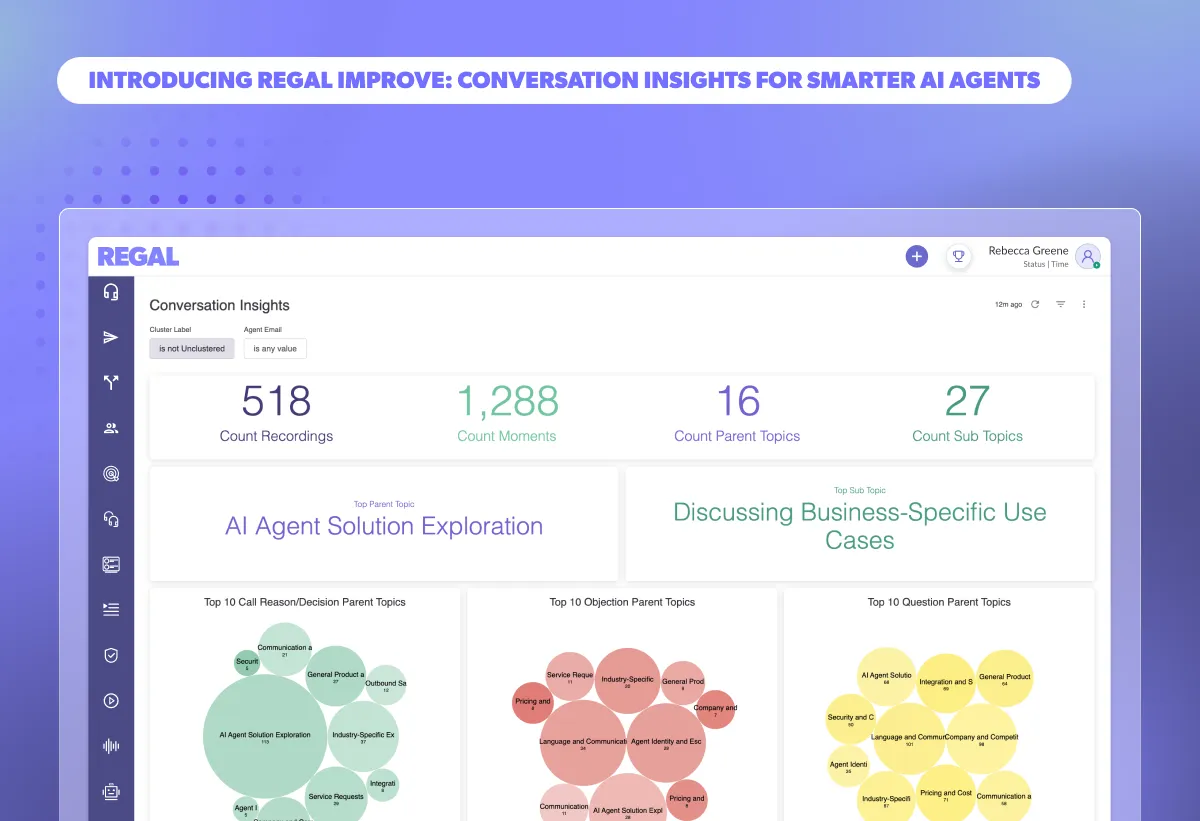
Customer conversations are inherently dynamic, and Regal Improve’s Knowledge Base Coverage tracks changes in retrieval performance over time and at scale. This makes it easy to verify that KB updates increase coverage and if your documentation is keeping up with evolving customer requests.
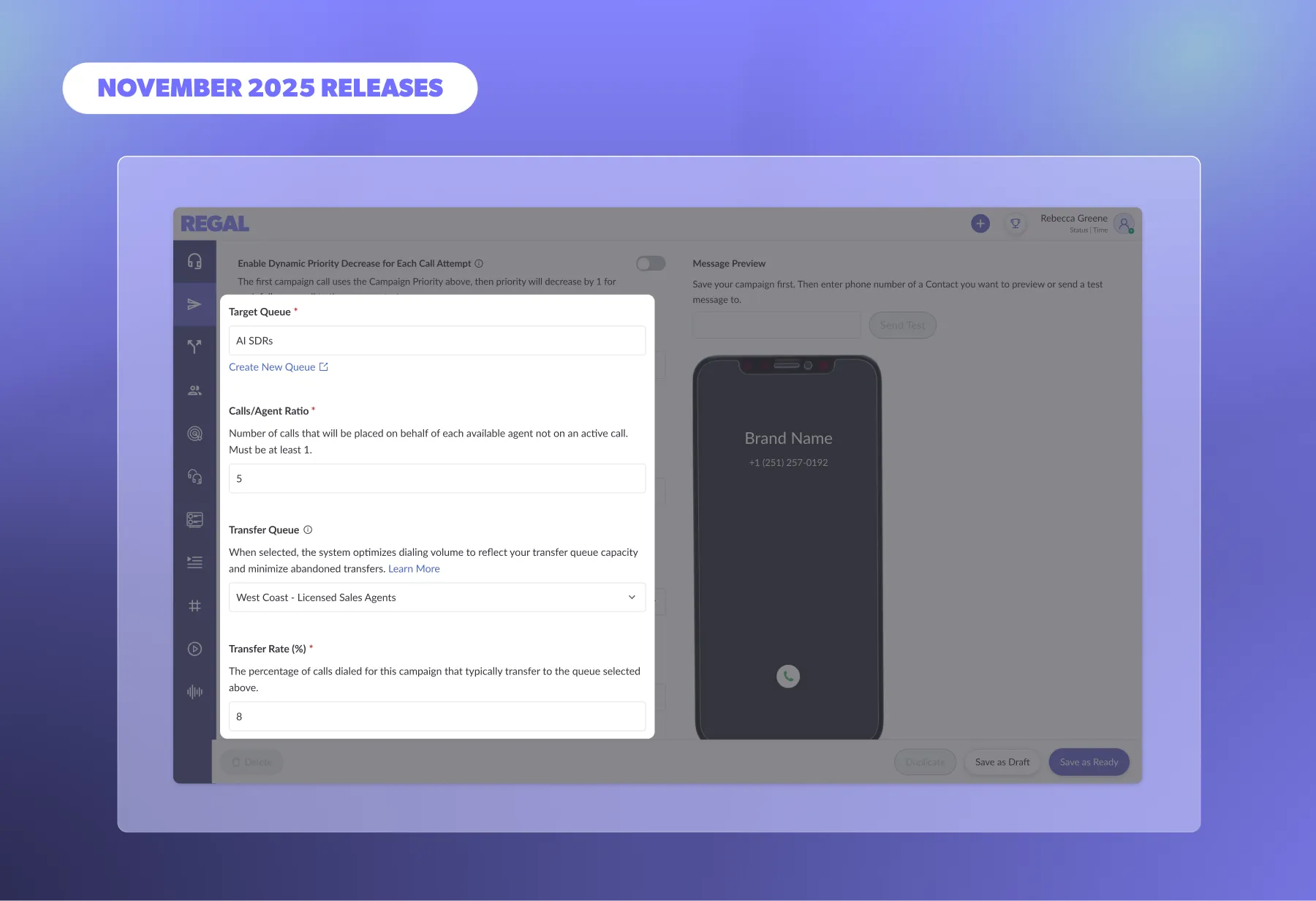
November's releases make it easier to scale your transfer-heavy call flows, with new tools that align dialer pacing to downstream agent capacity and streamline complex handoffs. You’ll also see improved post-call workflow accuracy, with reliable data extraction and disposition outcomes driven by LLM configurability and earlier validation.
.webp)
Building a great AI voice agent isn’t so different from parenting a five-year-old: clarity, examples, and structure make all the difference. This post breaks down proven prompting principles—from positive framing and persona design to conversational guardrails—that help AI agents sound natural, stay on task, and follow directions every time.
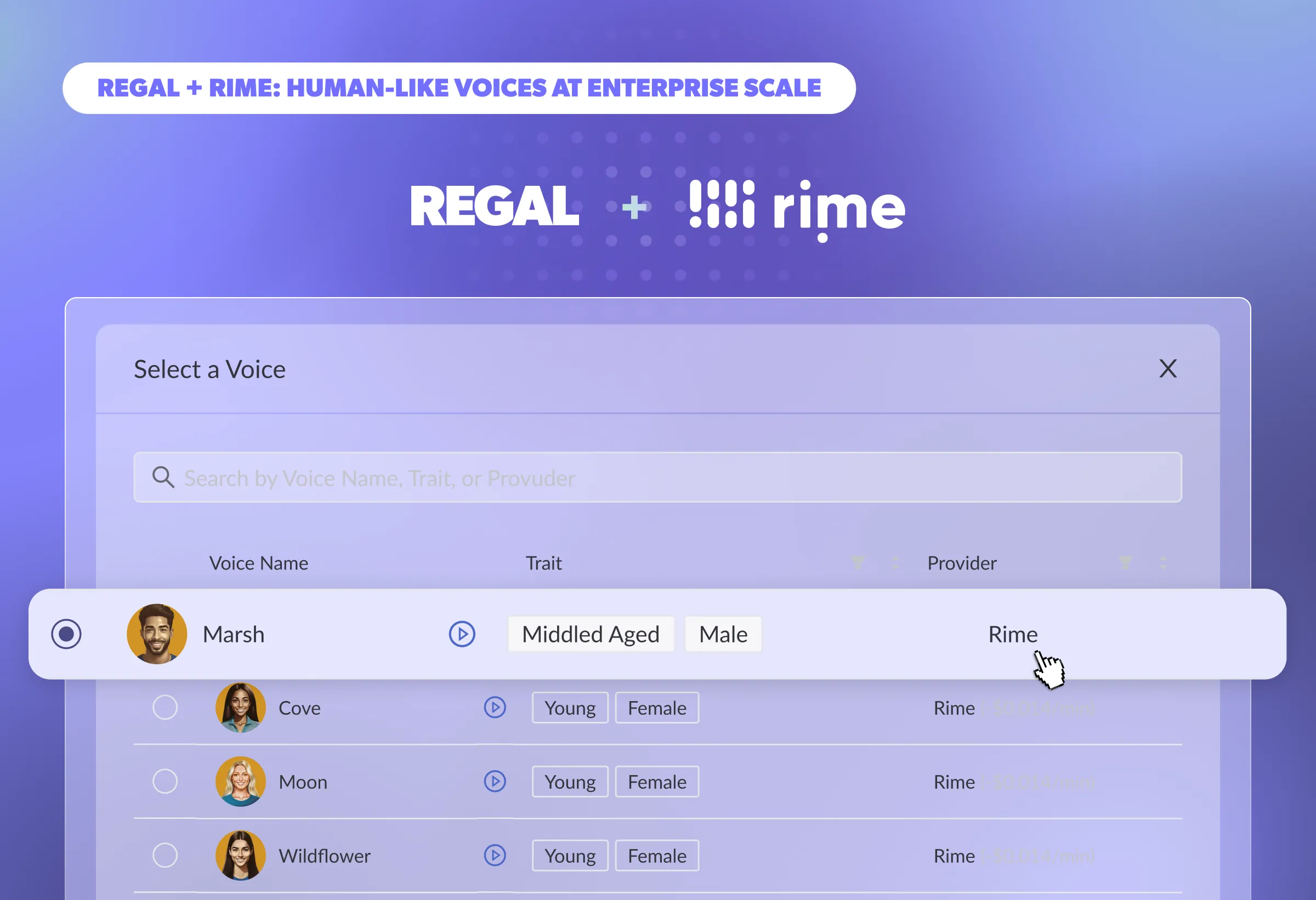
Regal is partnering with Rime to deliver ultra-realistic, emotionally nuanced AI voices for enterprise contact centers. Discover new voice options that capture human qualities like pacing, resonance, and subtle expression, and learn how Rime’s technology powers conversations that build trust at scale.
%20(1).webp)
Regal is partnering with Cartesia to deliver ultra-low latency, high-fidelity AI voices for enterprise contact centers. Explore new voice options, hear them in action, and learn about Cartesia's industry-leading voice AI offerings.

Why are so many contact centers stuck being cost centers? Why do they keep looking for cost reductions instead of revenue increases? Bad data and technology decisions are at the core of this issue. We need "marketing automation" (aka unified customer profiles, event-driven systems and a/b testing) like Regal.io in the contact center to empower teams to start looking for incremental revenue instead.

Consumer businesses are implementing AI-enabled customer experiences without any change in behavior on the part of consumers, which is leading AI to become common with more speed than past transitions like the internet and the smartphone. And it means that the next step in AI will not come from the LLM providers. The next big step forward in AI rests in the hands of consumer businesses.

Explore Eric Hauser's remarkable career journey from GovTech to healthcare disruption at Cadence, highlighting the transformative power of innovation, collaboration, with a special focus on the pivotal role of Regal in driving patient engagement and outcomes.

Discover how Regal.io's AI-powered personalized outreach solutions are revolutionizing outbound sales and customer experience across industries like healthcare, finance, and insurance in our latest eBook, "Modernizing Outbound Contact Centers: How to Treat Millions of Customers like One in a Million."
.jpeg)
Combining collaboration functionality into CCaaS workflow tools invites more cross-functional users from a company to participate in designing the end-customer experience, leading to better omni-channel orchestration and customer outcomes. Learn more about Regal's collaboration features.

Jon Heaps, former VP, Channel at Observe.ai, Talkdesk, and inContact interviews Alex Levin, Co-Founder & CEO of Regal.io, about the history of the contact center industry and some of the key challenges teams making outbound calls face as customers demand more online experiences.

Are you using Branded Caller ID for outbound calls or SMS? New SMS and Branded Caller ID regulations rolled out in Q2 2023 that you MUST KNOW ABOUT. The new regulations require that every company register their SMS campaigns and Branded Caller ID campaigns before being allowed to send texts or brand calls.

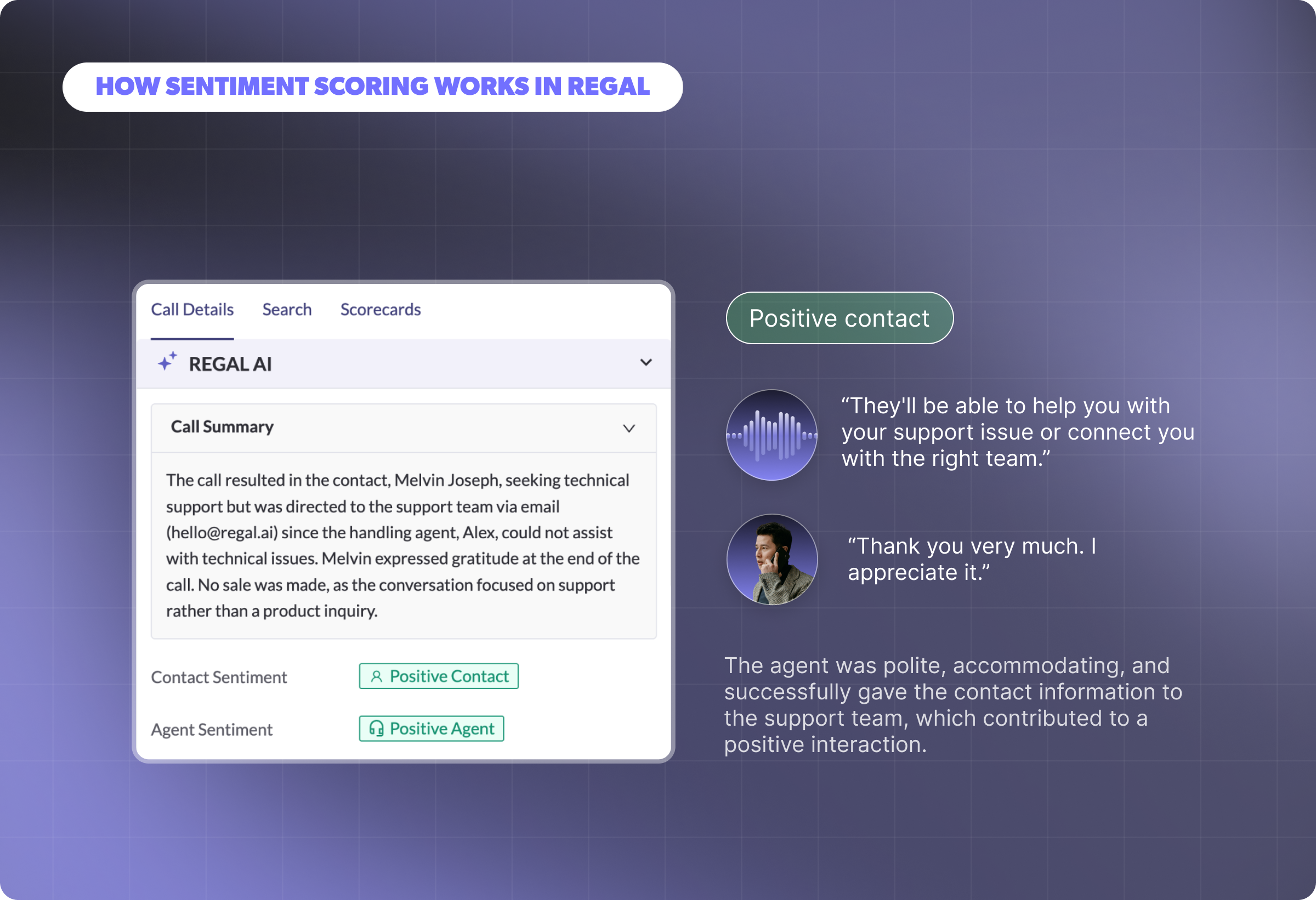
Regal’s Conversation Intelligence drives higher conversion rates for B2C sales teams. We use both the traditional QA/coaching tools, and brand new conversational triggers that allow you to update customer profiles and send automated follow up messages based on what is said in a conversation.

Caller ID, CNAM, and Branded Caller ID all help identify an incoming call and, therefore, increase call answer rates. Find out how they differ and how outbound phone sales teams can utilize each to reach prospects and customers effectively.

Our Co-Founder & CTO, Rebecca Greene, spoke with journalist Tony Zerucha at the recent Fintech Nexus USA 2023 event about how consumer lenders are using personalized phone and SMS sales outreach to obtain growth despite high inflation and rising interest rates.

The fastest growing High Consideration brands have invested heavily in outbound call centers for sales and marketing. With the right technology, staffing and measurement, you too can build a high performing outbound call center to help hit your growth goals.

We are excited to announce Regal Call Branding™ including Branded Caller ID. Available on all 400M wireless devices in the US (as well as most of Canada and the UK), Regal Call Branding™ puts you in control of what people see when you call their cell phone – including showing your brand and/or logo.

Get behind-the-scenes insights about Perry Health’s 23% revenue increase with Regal.io. Perry Health’s Scott Chesrown sat down with Regal.io and discussed how they implemented outbound sales technology, integrated new capabilities into their process, and built on their early success.

It’s the holiday season and you’d like to hit your December revenue goals. Outbound B2C sales during the holidays can be a major performance driver – if you're prepared and you have the right tools in place. Use these seven tips to get your outbound B2C sales in shape for holiday success.
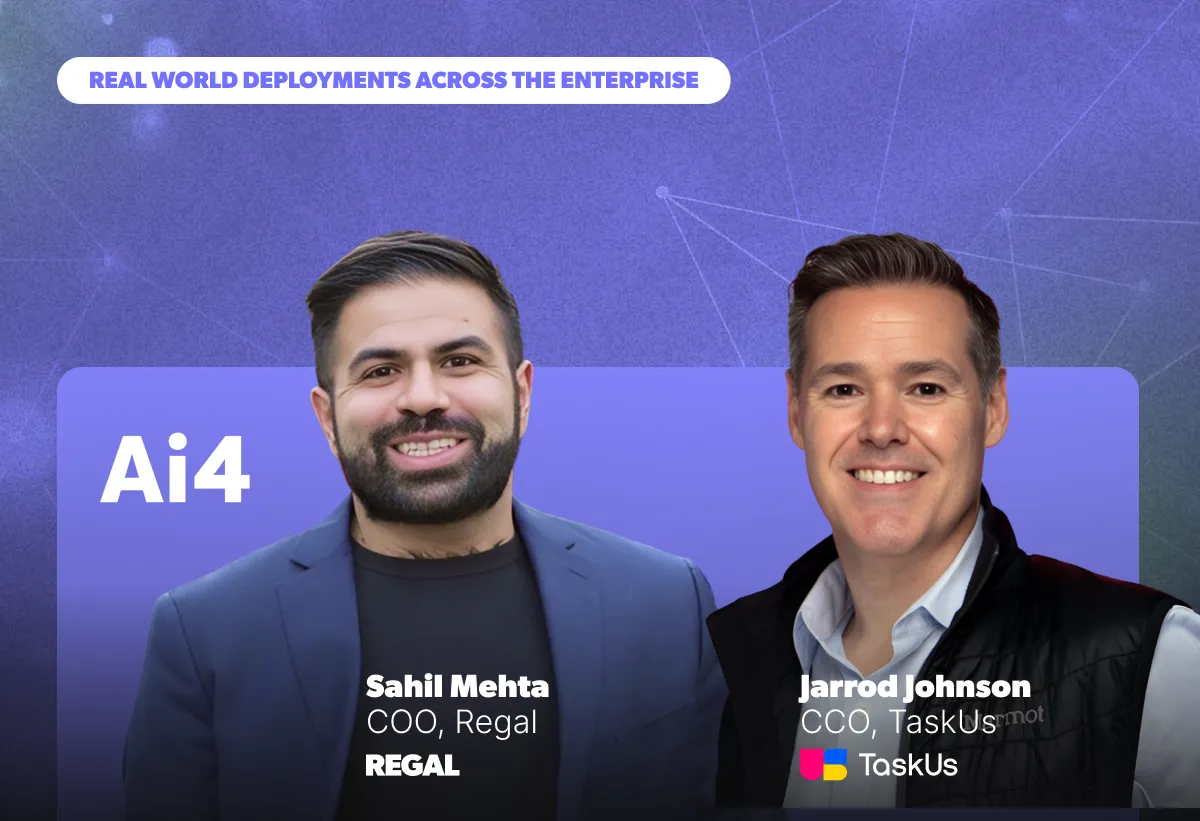
In this AI4 fireside chat, Regal.ai COO Sahil Mehta and TaskUs CCO Jarrod Johnson explore how enterprise organizations are deploying voice AI agents across customer experience, support, and sales. They share real-world deployments, discuss quality and ROI trade-offs, and outline best practices for aligning operations and product teams when adopting AI agents at scale.
.png)
Last month, we shipped releases that improve your contact center operations by extracting business insights with Copilot and reducing wasted agent minutes with our new Voicemail Detection model. The result is more reliable, productive AI agents that can drive revenue for your business.
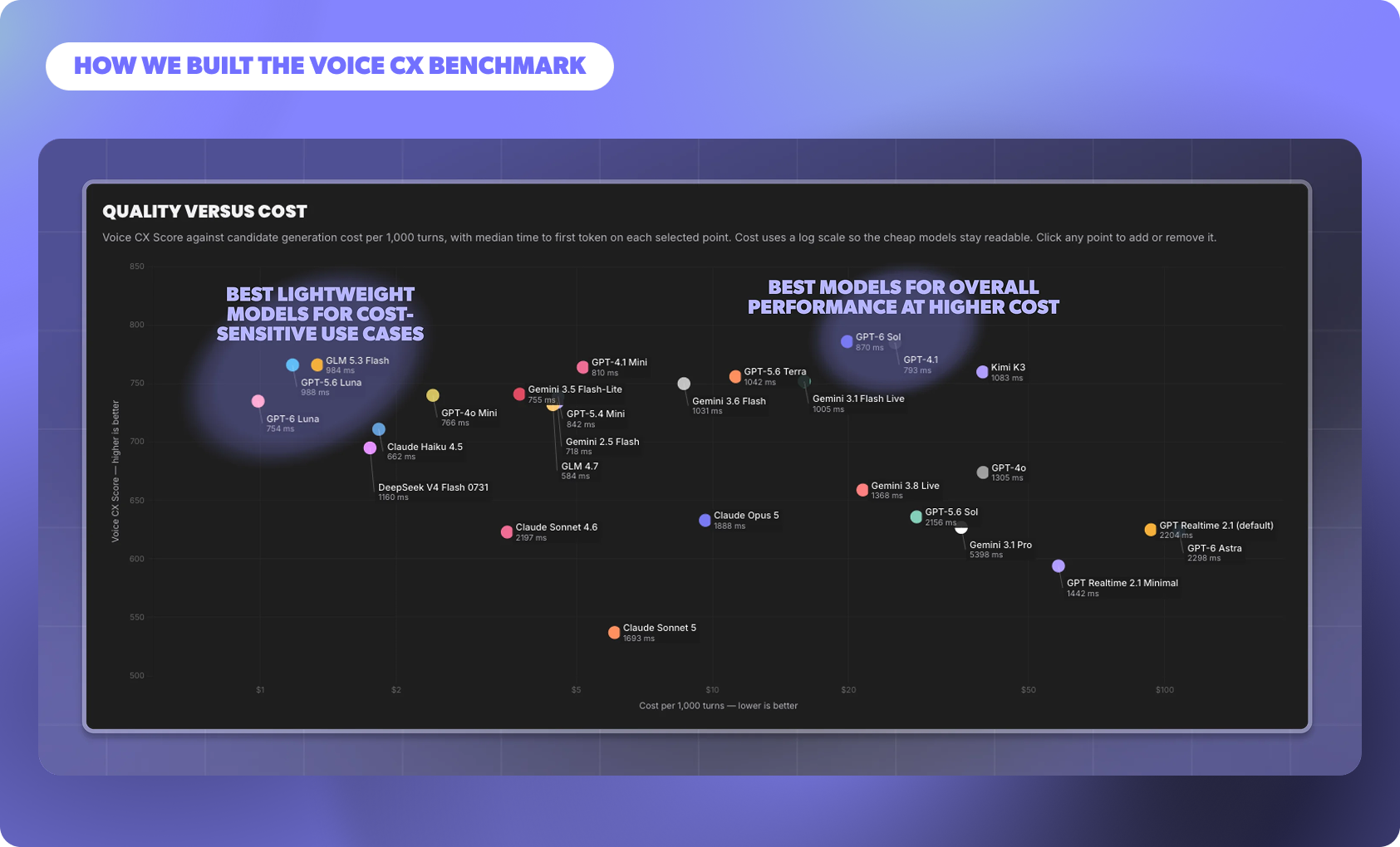
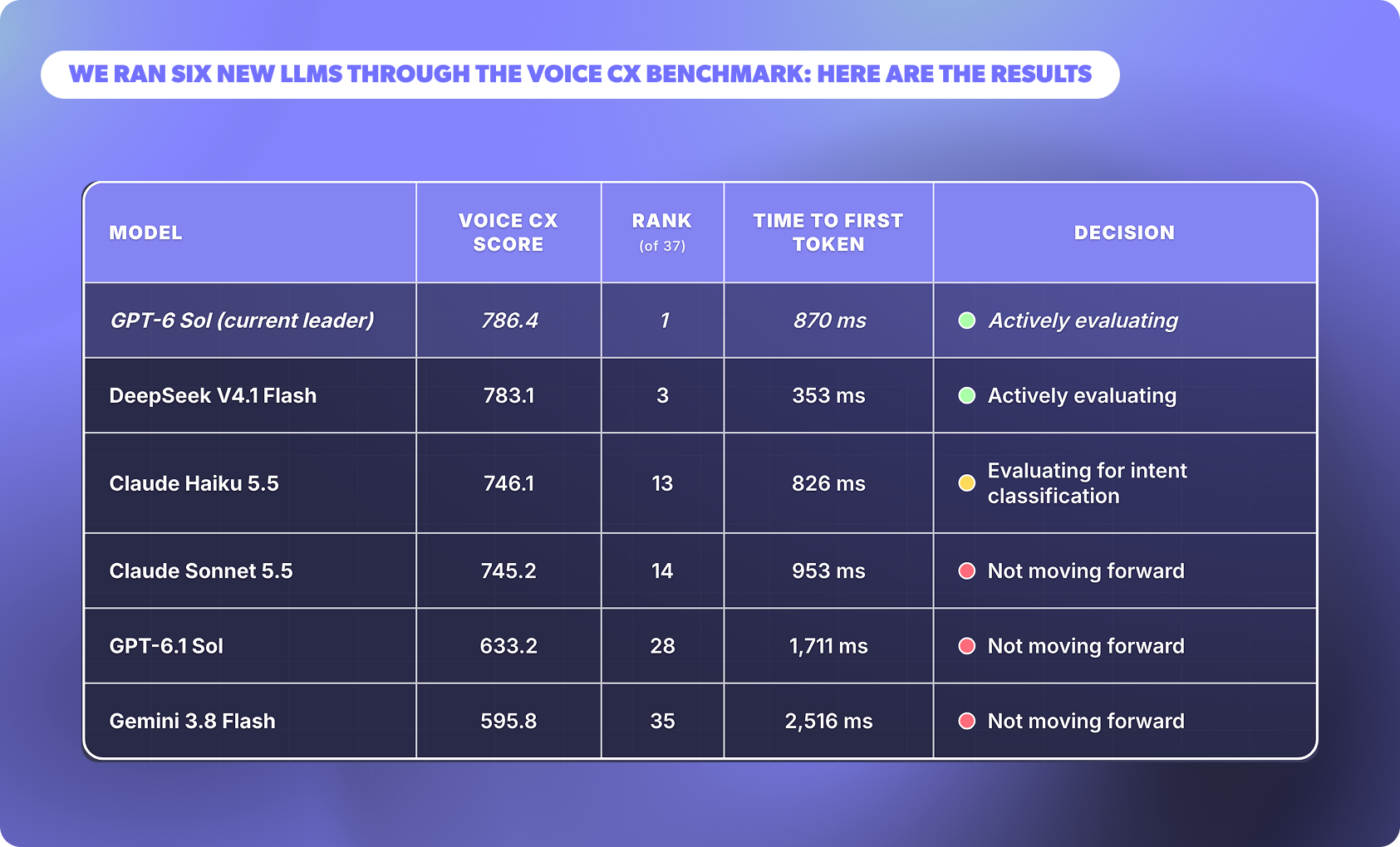
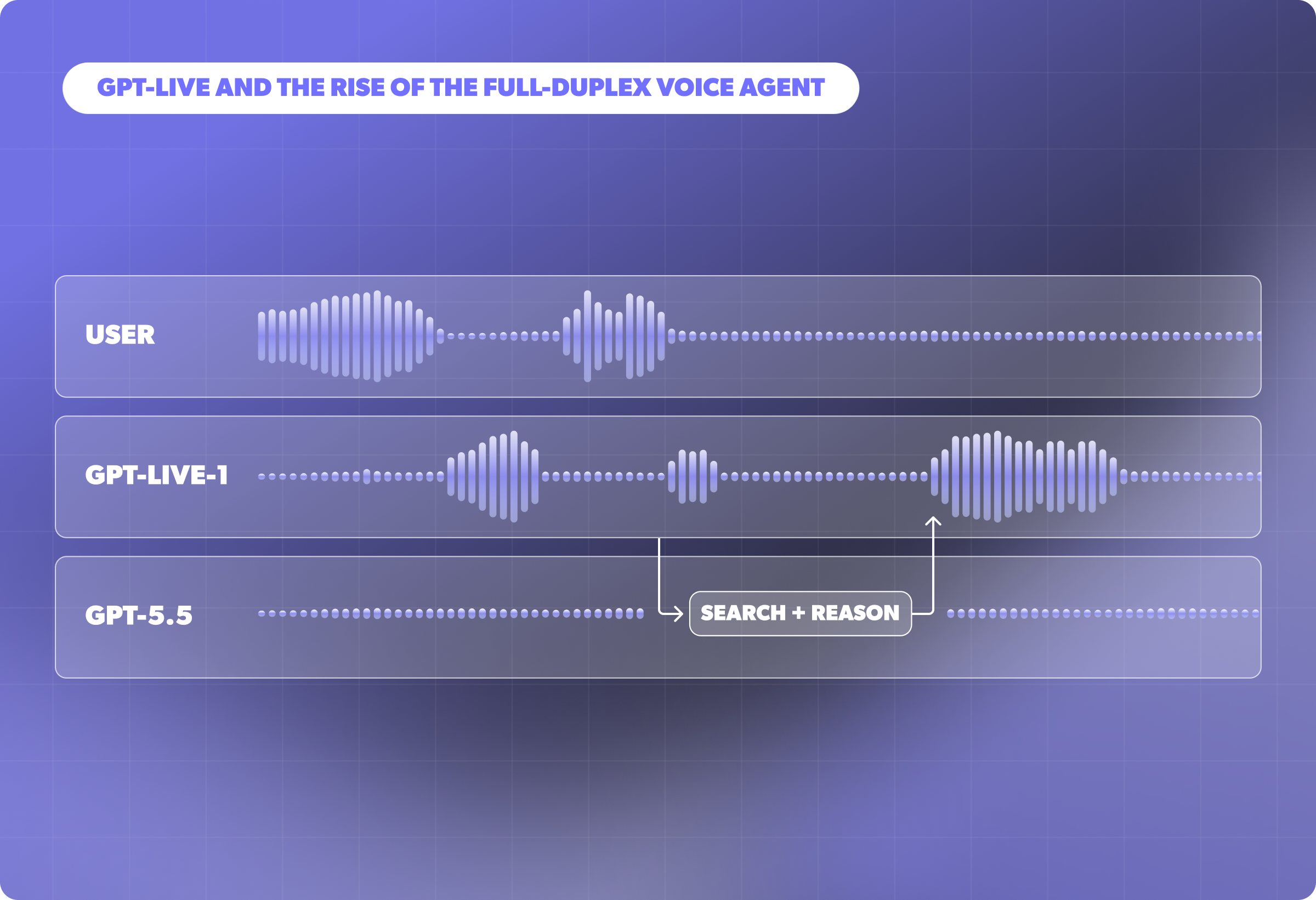
Enterprises need voice agents that hold a natural, human-like conversation while moving each call toward its goal and staying within compliance boundaries. The Voice CX Benchmark scores models on exactly that: how well they progress the call turn by turn, how safely and clearly they communicate, and how quickly they respond.
.png)
With Regal’s next-generation Voicemail Detection model, you can now classify voicemail, iOS or Google call screeners as separate categories with very high accuracy. This enables screener-specific handling, ultimately reducing missed agent connections.
.png)
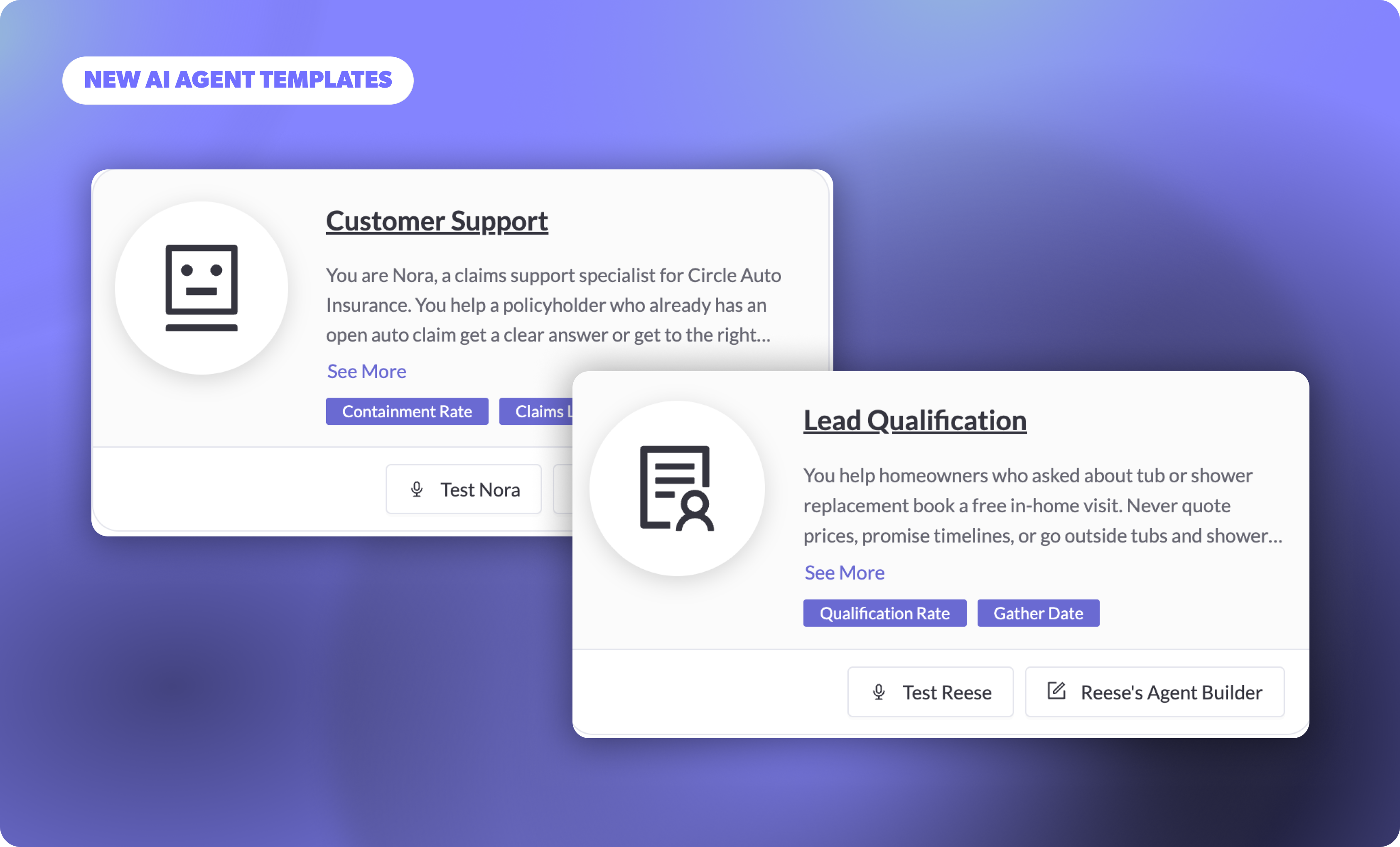
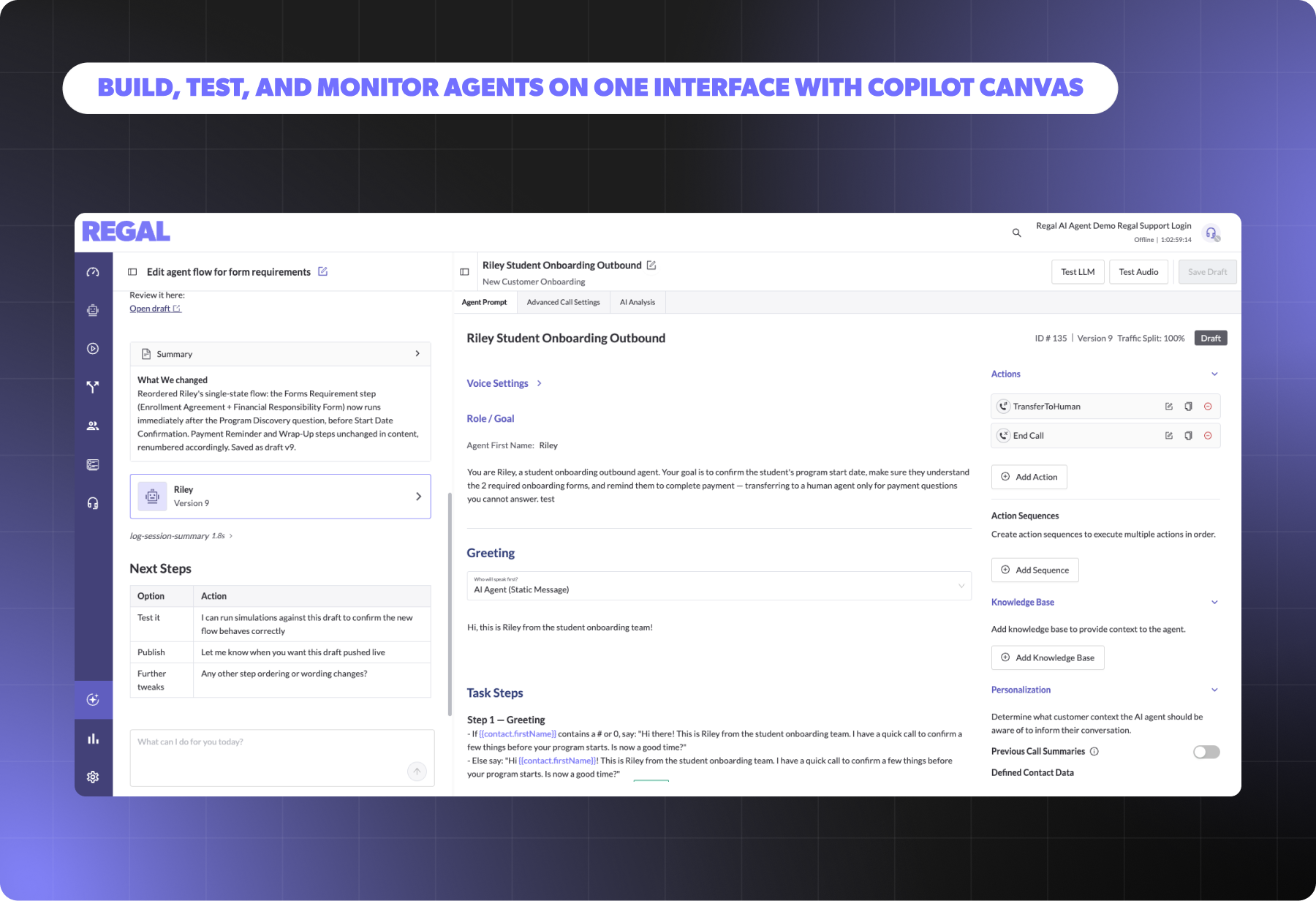
Last month, we shipped releases that make it easier to build, monitor, and test agents in one interface. Copilot Canvas brings building, editing, and testing into one interface and it can work straight from your files. Multi-state sticky notes let your team document decisions directly on a live agent.
.png)
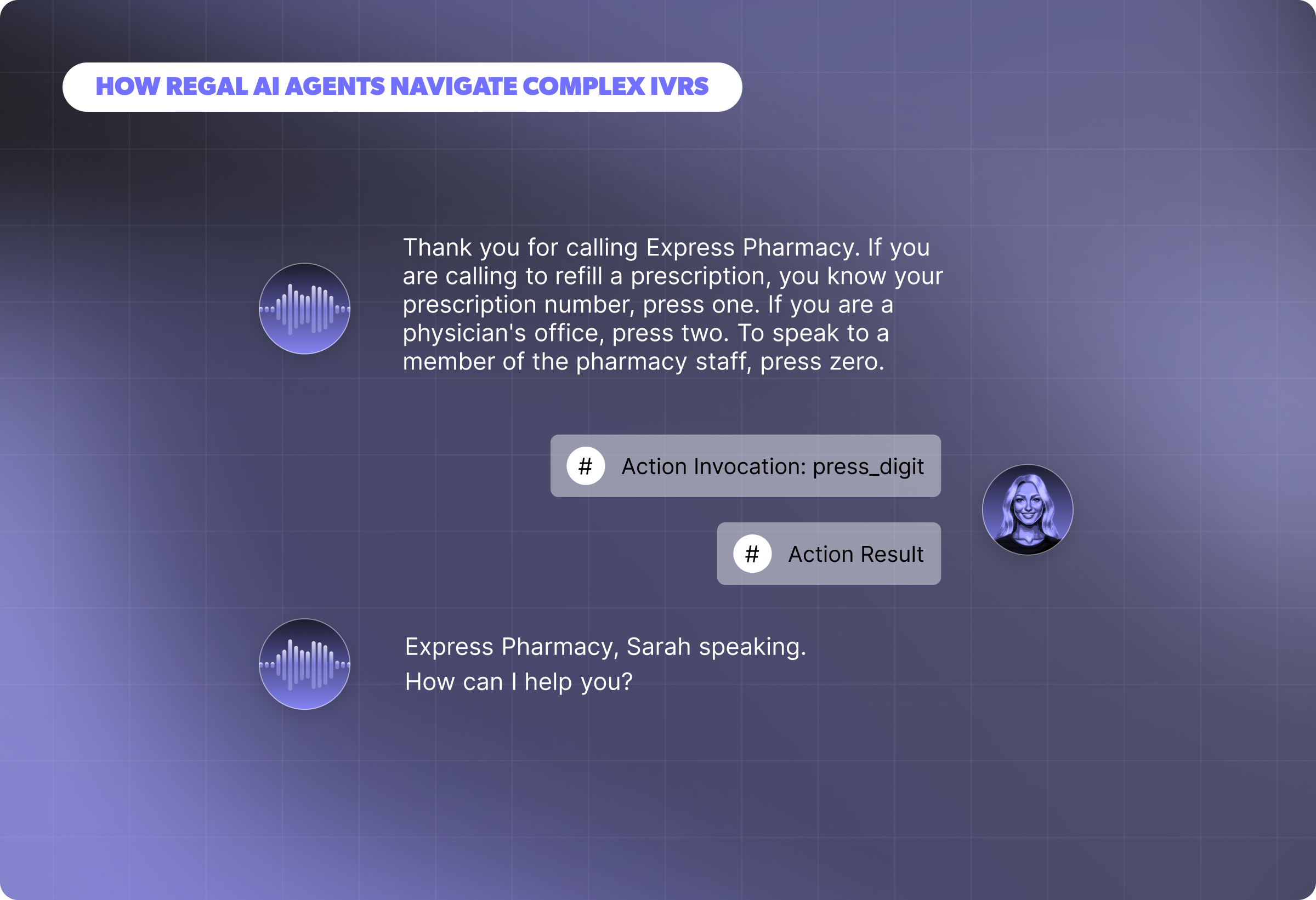
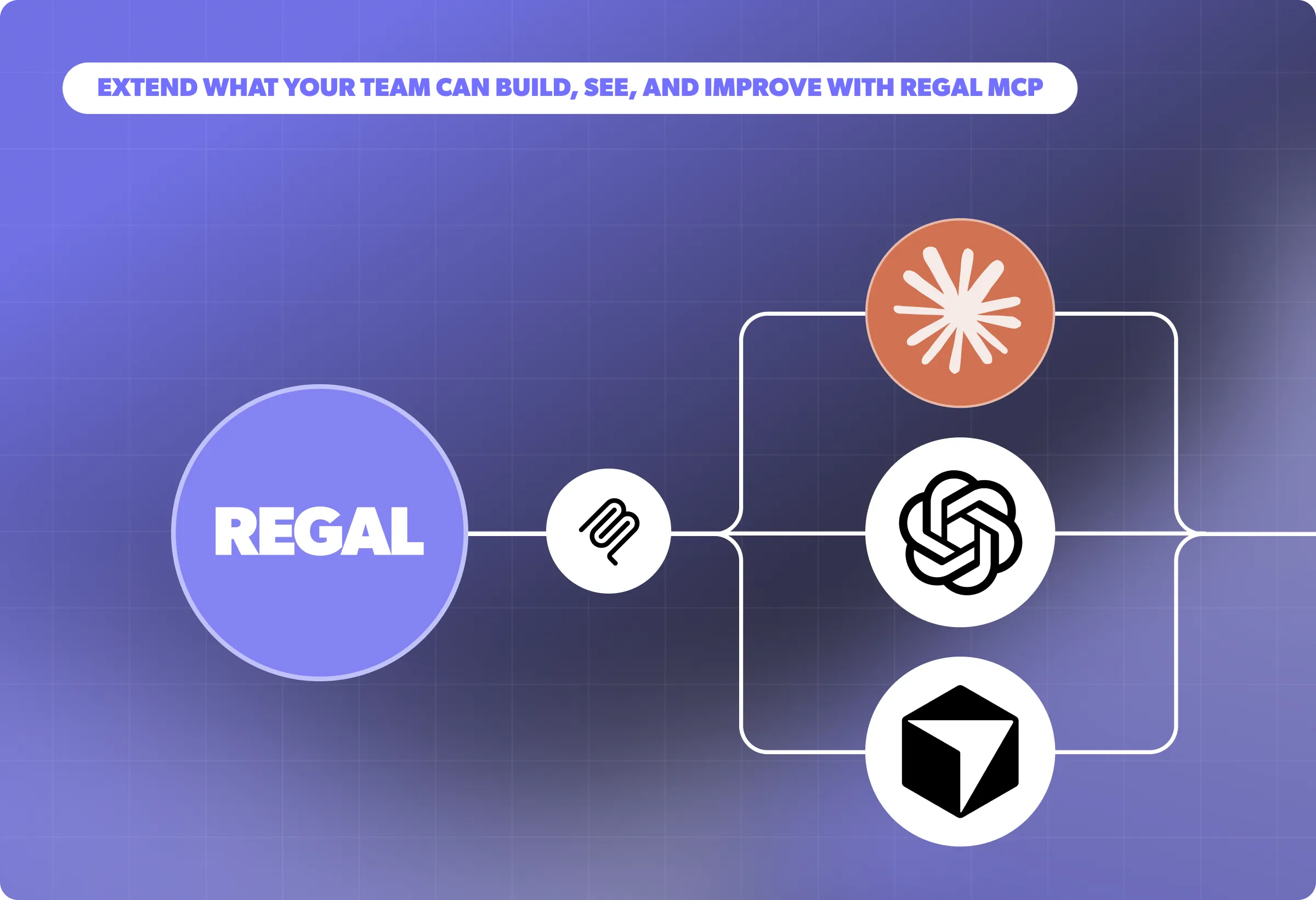
Last month, we launched features that extend your management of AI agents via MCP and CCaaS platforms. Debug based on agent versions or simulation runs, and manage AI analysis data points via Copilot and Regal MCP. As a Five9 AI Agent Connect partner, Regal now has a dedicated integration API built for Voice AI agents.

AI phone agents aren't just better phone trees. They are autonomous systems that can understand caller intent, retrieve relevant information from your CRM in real time, execute actions, handle objections and clarifications, and complete the conversation without human involvement.
.webp)
When prospects in healthcare and financial services hear "PII," they often imagine bulk data transfer: the idea that deploying an AI agent means copying a database somewhere. In most modern deployments, that's not what's happening.

%20(1).webp)
.webp)
%20(1).webp)


.png)
.png)
.png)
.png)

.avif)
.webp)
.webp)
.webp)
.webp)
.webp)