Why “Sounding Nice” Fails: Engineering Empathy in AI Agents

A customer says, quietly, “I’m… kind of overwhelmed. I don’t even know where to start.”

Your AI agent replies: “Great. Please confirm your date of birth.”

And just like that, you’ve lost them.

Not because the agent was “rude” or lacked empathetic language.

You lost them because the system moved to the conversational step without earning permission to proceed.

That’s the central misunderstanding in most AI deployments: teams treat empathy like as a copy problem (tone) when it’s actually a systems problem, governed by timing, state awareness, decision logic, guardrails, and recovery paths.

In this guide, I’ll break down what empathetic AI means in operational terms, why “sounding nice” fails, and the framework we use to design agents that maintain trust through customer confusion, hesitation, interruptions, and compliance checkpoints.

And yes—empathy matters because it drives outcomes. In one healthcare intake scenario, we saw meaningful drop-off reduction at a required compliance moment after redesigning the agent’s approach to acknowledgement, framing, and permissioning.

But empathy has a second edge: when teams chase “humanness” without guardrails, they risk creating agents that go off-script, violate compliance requirements, or (in one infamous case) start swearing at customers.

In this guide, you’ll learn how to build an agent that balances empathy with control, and drives real results in production.

What “empathetic AI” actually means

Empathetic AI isn’t just defined by “warm language.” It’s a set of behaviors that protect the contact’s emotional state and still moves the core task forward.

Operationally, an empathetic agent does three things consistently:
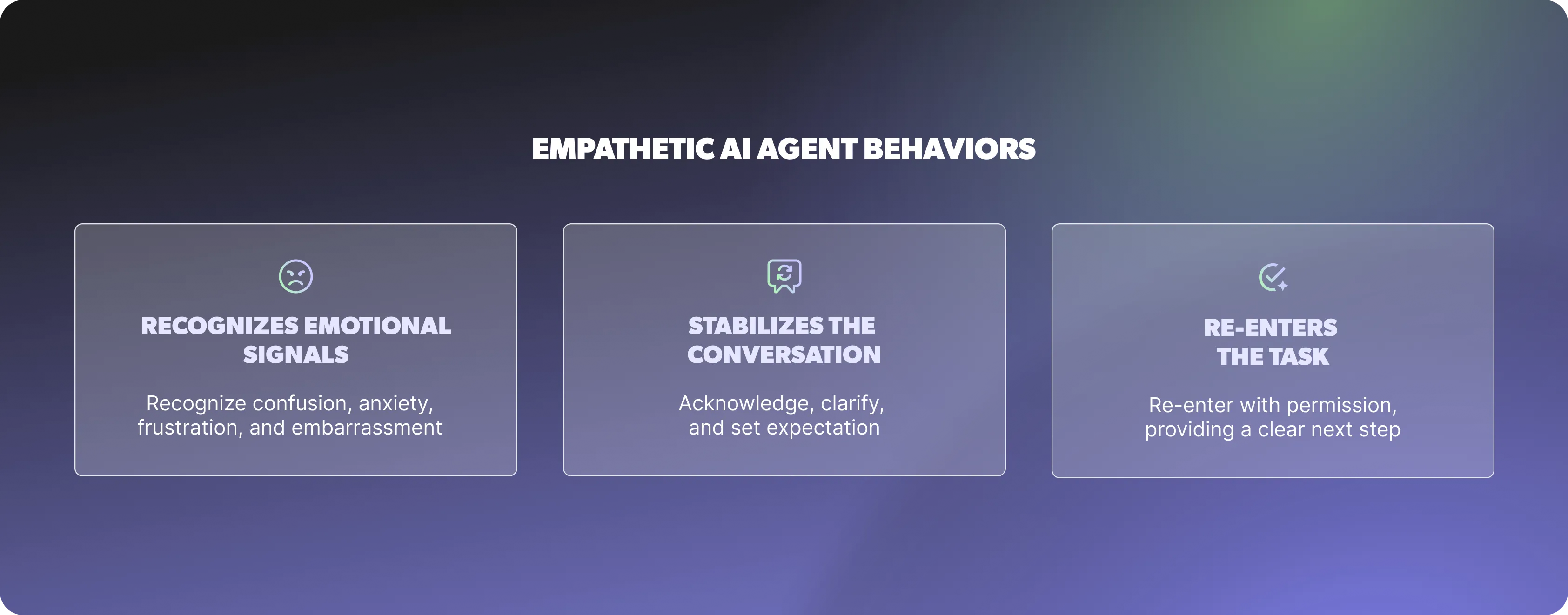
  1. Recognizes emotional signals (i.e., confusion, anxiety, frustration, embarrassment, vulnerability).
  2. Stabilizes the conversation (acknowledge, clarify, and set expectations).
  3. Re-enters the task with permission (providing, not forcing, a clear next step).

Most real customer conversations don’t fail on the happy path. They fail at the edges:

  • “Wait, why do you need that?”
  • “I’m not comfortable sharing this.”
  • “I don’t understand what you mean.”
  • “I’m driving.”
  • “I’ve been trying to fix this for weeks.”
  • “I’m scared this won’t be covered.”

Empathy is how you keep the conversation alive long enough to help—empathetic agents optimize for continuation and trust, not just containment.

The myth: empathy is rarely about tone

Many teams ship a “robotic” agent, realize contacts hate it, and then try to fix the problem by making it “warmer”—adding empathetic phrases, selecting a friendlier voice, or tweaking prompts—without changing the underlying system behavior. 

Those changes can help at the margins, but they don’t address the core failure modes:

  • Identity mismatch: the agent doesn’t act like it has responsibility.
  • Context blindness: it treats every contact like a cooperative form-filler.
  • Timing failures: it advances the flow before the contact is ready.
  • No recovery path: it can’t pause, repair, and re-enter the task when things break down.
  • Missing guardrails: it tries to be “human” by improvising—exactly what regulated contexts prohibit.

Empathy isn’t a coat of paint. It’s the structure of the building.

Voice vs chat: same brain, different empathy

Voice and chat require different empathy models, even when sharing the same underlying system.

Voice: pressure and timing

Voice is real-time. Contacts interrupt, ramble, and whisper. They pause the conversation to talk to others in the room. They lose signal. They change their mind mid-sentence.

Empathy in voice is heavily shaped by pacing and turn-taking:

  • Micro-pauses before asking sensitive questions
  • Not talking over the contact
  • Treating interruptions as signals, not errors
  • Using short confirmations so the contact feels heard

A Voice AI agent can correctly follow conversational steps and still feel unnatural if it rushes between them.

Chat/SMS: structure and consistency

Chat has different constraints:

  • Formatting is the interface.
  • Ambiguity lives longer (the contact can re-read confusing messages).
  • Drift compounds over time, making inconsistencies visible in the conversation log.

Empathy in chat often looks like:

  • Short, clear blocks
  • One acknowledgment sentence
  • One next question
  • Consistent restatement of constraints

Same underlying intelligence. Different failure modes.

Empathy across the stack

If you’re building Voice AI agents, empathy isn’t located in one place. It’s distributed across:

  • Speech-to-text (STT): what the system interprets the contact said, including hesitation, corrections, or uncertainty
  • LLM (reasoning and policy): how the agent decides what to do next
  • Text-to-speech (TTS): how the decision is delivered via pacing, tone, and responsiveness

If any layer breaks, empathy breaks.

Chat follows the same idea with different layers:

  • Model output
  • Structure and formatting
  • Memory and consistency across turns

This is why just tweaking the prompt often fails. You can’t prompt your way out of a broken turn-taking system.

The 5 levers of empathetic AI:

We rely on the  framework below  because it’s enforceable. It doesn’t rely on “good vibes” or stylistic updates.
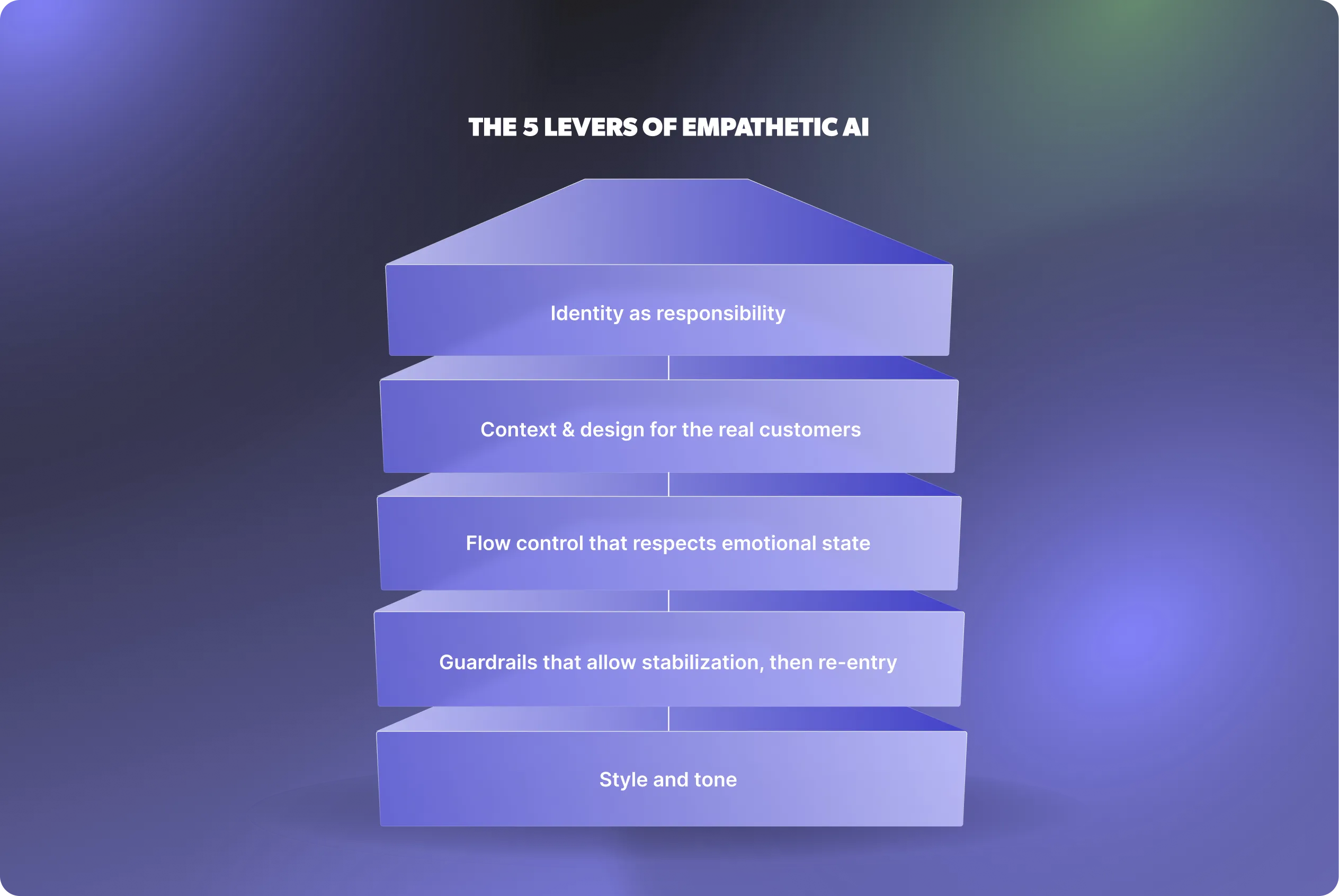
1. Identity as responsibility (not role-play)

Most agents have an identity like: “You are a helpful assistant.” That’s not enough.

An empathetic agent needs identity defined as explicit responsibilities:

  • Protect the user’s emotional state during sensitive moments.
  • Be patient through confusion and repetition.
  • Explain why information is being requested when stakes are high (privacy, payment, eligibility, medical info).
  • Never advance the flow without consent after a hesitation signal.


When identity is framed as responsibility, “empathy” becomes a policy the agent must follow.

2. Context modeling: design for the real customers

If your agent assumes a calm, cooperative contact, it will fail on real ones.

Instead, model common states as expected contexts:

  • Confused
  • Skeptical
  • Tired
  • Distracted
  • Embarrassed
  • Anxious
  • Frustrated


Then define behaviors for each:

  • Confused: restate in simpler words + offer options
  • Skeptical: explain why you’re asking + offer a choice (continue / talk to human)
  • Anxious: slow down + confirm you’re going step-by-step


If you don’t model these states, the agent will interpret them as obstacles, and contacts will feel it.

3. Flow control that respects emotional state

This is the biggest difference between robotic and empathetic systems.

Robotic agents advance the workflow by default:

“Thanks for sharing. Before we continue, federal policy requires me to read you a brief privacy statement and then we’ll jump right back in. I’ll begin reading now.”

Empathetic agents regulate the flow based on user state:

“Thank you for sharing. Insurance can feel really overwhelming, especially when you’re dealing with multiple health issues and appointment scheduling. Before I connect you, I just need to confirm a few details, does that sound okay?”

Flow control means resisting the urge to push the interaction forward after a hesitation signal, adding explicit gates around sensitive moments, and using permissioning (“Is it okay if we continue?”) before advancing. This is where drop-off is either prevented or guaranteed.

4. Guardrails that allow stabilization, then re-entry

In regulated workflows, you can’t let the agent “wing it.” But you also can’t force the agent to stay on rails so tightly that it steamrolls emotions.

The solution is controlled flexibility:

  • Allow brief deviation for stabilization (acknowledge, clarify, reassure)
  • Then re-enter the task with a clear next step
  • Maintain compliance requirements throughout

This is the difference between empathetic systems and uncontrolled ones.

A real cautionary tale: there have been public incidents where customer-service chatbots went wildly off-script, swearing at customers and trash-talking the company. You don’t need to experience that  to understand the cost implications.

The point isn’t to avoid being human. It’s to be human within boundaries.

5. Style and tone as the final layer

Tone matters, but it’s not the foundation.

Once the agent makes the right decision (pause, explain, permission), tone simply delivers it calm, clear, brief, and respectful.

Tone cannot override policy. If the flow is wrong, warm words make it worse.

The “expected scenario”: the privacy statement moment

In healthcare, insurance, and financial services, a familiar pattern emerges. A required script—privacy disclosure, recording notice, consent—is introduced, and customer behavior shifts.

They get nervous.

They ask “Why?”

They say “I don’t want to do this.”

They go silent.

A robotic agent treats this as noncompliance and pushes harder. An empathetic agent treats it as a trust checkpoint.

Empathetic by design in that moment includes:

  1. Acknowledging the discomfort without dramatizing it
  2. Framing the purpose in plain language
  3. Offering control (continue, ask questions, or transfer)
  4. Requesting permission before proceeding


Sample phrasing: “Totally fair to ask. This statement is here to protect your privacy and explain how your information is used. I am required to read it by law, but I can explain any part of it before we continue, or connect you to a person, but they will still have to read it as well—what would you prefer?”

That’s not “nice.” That’s structural.

Voice-specific empathy techniques

If you’re building Voice AI agents, the empathy-building tactics below  aren’t cosmetic, they’re essential.

Pick the right voice: select voices based on audience and context, using deeper voices for contacts with hearing difficulties, calm and neutral voices for longer or complex flows, and warmer, younger voices for standard interactions. 

Tweak pacing and responsiveness: slow slightly for sensitive use cases or older audiences, insert micro-pauses before long statements or when requesting private information, and avoid instant turn-taking that feels like interruption.

Treat interruptions as meaning: interpret interruptions as indicators of confusion, anxiety, urgency, or disagreement rather than errors, and design the agent to yield and repair instead of forcing continuation (e.g., “Got it—go ahead. What’s on your mind?”).

Use the “Acknowledge → Frame → Ask permission” pattern: apply this pattern ahead of high-friction moments such as privacy or compliance disclosures, payments, eligibility denials, or long holds to preserve trust while continuing the interaction.

Chat-specific empathy techniques

Chat empathy is largely about structure.

Design for structure: treat formatting as the interface, using short blocks and explicit steps rather than dense paragraphs.

Break messages into components: lead with a one-line acknowledgment, follow with a single clear next question, and include optional choices when relevant. For example, “That makes sense. This can be confusing. Quick question so I can help: are you trying to reschedule, cancel, or check availability?”

Optimize for brevity without dismissiveness: avoid long explanations; one sentence of acknowledgment is sufficient when the next step is clear and concrete.

Prioritize consistency over charm: maintain stable constraints across the thread, and restate key rules when necessary—what the agent can and can’t do, what information is required, and what will happen next.

How to measure whether empathy is working

Since empathy is architectural, you can measure it.

Start with the moments where agents most often fail: privacy/compliance statements, payment collection, eligibility denial, long wait times or hold messages, and scheduling constraints.

Then track:

  • Drop-offs at hard moments (the best signal)
  • Repair rate after interruptions (does the contact continue?)
  • Repeat-question rate (a proxy for confusion)
  • Escalation patterns (when appropriate)
  • Sentiment shifts around known friction points

In one healthcare intake scenario, redesigning the privacy-statement moment with acknowledgment, framing, and permissioning significantly reduced drop-off at that exact step.

You don’t need perfect sentiment analysis to learn this. You need visibility into where contacts disengage and whether the system successfully recovers.

The iteration loop: how empathy is engineered

Don’t try  to make the agent “empathetic everywhere.” Instead, start here:

  1. Ship a baseline flow that works on the happy path.
  2. Identify the top 3 abandonment moments.
  3. Patch those moments using the five levers: identify responsibility, context, modeling, flow control, guardrails and re-entry, and tone.
  4. Retest with real conversations.
  5. Repeat.

Empathy is not a sprint. It’s an operating system update.

Closing: empathy is architectural

Robotic AI fails because it treats humans like form fields.

Empathetic AI succeeds when it treats the conversation like a relationship with stakes, where trust must be earned, confusion must be handled, compliance must be respected, and control remains with the user.

Empathy doesn’t come from wording alone. It’s designed through five levers:

  1. Identity as responsibility
  2. Context modeling
  3. Flow control
  4. Guardrails that stabilize, then re-enter
  5. Tone as the final lever


Schedule a demo today
to see how Regal can design an empathetic agent for your use-case that drives retention and conversion.

Frequently Asked Questions

What does "empathetic AI” mean?

Empathy shows up differently between voice and chat because the interaction constraints are different. In voice, empathy is expressed through pacing, turn-taking, and handling interruptions naturally in real time. In chat, empathy comes through clear structure, explicit acknowledgments, and consistency over time so the conversation remains easy to follow.

How does empathy show up differently between voice and chat?

Empathy shows up differently between voice and chat because the interaction constraints are different. In voice, empathy is expressed through pacing, turn-taking, and handling interruptions naturally in real time. In chat, empathy comes through clear structure, explicit acknowledgments, and consistency over time so the conversation remains easy to follow.

Can I add empathy to my agent by just adjusting the prompt?

No, your agent’s empathy depends on multiple layers working together: speech-to-text (how well hesitation or corrections are interpreted), the LLM (how decisions are made), and text-to-speech (how responses are delivered through tone, pacing, and timing). If any of these layers break, empathy breaks too.

w can I measure whether empathy in my agent is working?

To measure for success, focus on behavior, not just wording. Measure drop-offs at high-friction moments (like privacy statements or payment collection), repair rates after interruptions, repeat-question rates, escalation patterns, and sentiment shifts around known pain points. These signals show whether contacts stay engaged and whether the system successfully recovers when interactions get hard.

Founded in 2020, Regal is an enterprise voice AI agent platform for contact centers. Regal helps businesses build, deploy, and manage autonomous AI agents across sales, support, and operations teams.

Latest Blog Posts

SEPTEMBER 2023 RELEASES

September 2023 Releases

Read More
SEPTEMBER 2023 RELEASES

September 2023 Releases

Read More
SEPTEMBER 2023 RELEASES

September 2023 Releases

Read More
January 2026 Releases

In 2026, we're focused on making every interaction with your AI agent feel more human, and speeding up the agent development process so you can drive results faster. We kicked off the year by advancing the reach and contextual intelligence of AI agent conversations.

Read More
Voice AI Customization 101: Settings That Work Best

Learn how to configure your AI Voice Agent for real performance. This guide covers the most important voice settings in Regal, what ranges top brands use in production, and how adjusting speed, tone, and responsiveness impact cost, containment, and overall customer experience.

Read More
Introducing WebRTC Voice: Click to Talk, Right From Your Website

WebRTC Voice enables real-time voice conversations: instead of dialing phone numbers or switching applications, customers can enable voice conversations directly in your website widget.

Read More
Support Customers Directly on Your Website with Chat AI

Now, you can embed Chat AI directly into your site, providing customers with dynamic, contextual responses that move them toward a decision.

Read More
From Bottleneck to Breakthrough: Creating Delightful Experiences with Voice AI Agents

At the AI Summit New York, Regal Director of Product & Product Marketing, Yael Goldstein shared how enterprise organizations are moving beyond theory to deploy Voice AI agents that transform customer experiences.

Read More
December 2025 Releases

December's releases expand where and how you can deploy and scale your AI agents, including a new embeddable website widget for chat and WebRTC. We also released several features to increase observability across the Regal platform.

Read More
The Voice AI Agent Triangle: Speed, Control, Expression (Pick Two)

Every production Voice AI agent is a tradeoff system. Successful Voice AI agents are deliberately constrained, and those constraints can be visualized in The Voice AI Agent Triangle.

Read More
Turn AI Agent Data Into Better Customer Interactions: A Timeline-Based Approach

Leverage real-time decision-making and post-call analysis to increase personalization in your customer interactions, evaluate your agent long-term, and extract insights for continuous improvement. ‍

Read More
2025 Product Recap: Building the Voice AI Agent Platform for Enterprise

Learn about the 2025's product highlights, from the AI Agent Builder to Simulations, deeper observability, and automated insights for continuous improvement at scale.

Read More
How eHealth Elevated the Medicare Experience with Always-On Voice AI

eHealth’s AI agent streamlined Medicare enrollment and support by scaling up for peak call surges, eliminating after-hours wait times, and delivering exceptional experiences for beneficiaries.

Read More
2025 in Review

Celebrate a milestone year as Regal customers scaled AI Agents to 350M calls in 2025, and get a preview of Regal's vision for 2026 to help teams build and improve agents faster, with less effort.

Read More
Pinpoint Critical Knowledge Base Gaps with Regal Improve

‍Customer conversations are inherently dynamic, and Regal Improve’s Knowledge Base Coverage tracks changes in retrieval performance over time and at scale. This makes it easy to verify that KB updates increase coverage and if your documentation is keeping up with evolving customer requests.

Read More
November 2025 Releases

November's releases make it easier to scale your transfer-heavy call flows, with new tools that align dialer pacing to downstream agent capacity and streamline complex handoffs. You’ll also see improved post-call workflow accuracy, with reliable data extraction and disposition outcomes driven by LLM configurability and earlier validation.

Read More
How to Make Voice AI Agents Think and Act Like Your Best Human Agents

See how modern AI voice agents can match your best human reps by building five core capabilities into every call: spatial awareness, temporal awareness, sensory perception, proactive retrieval, and real action-taking. This post breaks down what each pillar means in practice and how they turn voice AI from a conversational bot into a fully empowered operator.

Read More
Teaching Voice AI to Behave: Prompting Principles Every Parent Already Knows

Building a great AI voice agent isn’t so different from parenting a five-year-old: clarity, examples, and structure make all the difference. This post breaks down proven prompting principles—from positive framing and persona design to conversational guardrails—that help AI agents sound natural, stay on task, and follow directions every time.

Read More
Introducing the Multi-State Agent Builder

Introducing Regal’s Multi-State Agent Builder, a purpose-built tool for orchestrating complex, non-linear conversations. Gain full control over prompts, logic, and actions to scale AI agents with accuracy, personalization, and enterprise reliability.

Read More
How Kin Insurance & a360inc Achieved Faster Outreach and Better Customer Experiences with AI Agents

In this fireside chat, Regal Co-Founder & CEO Alex Levin sits down with Kin Insurance’s Austin Ewell and a360inc’s Henry Davidson to share how their organizations are using AI agents to transform outreach, customer experience, and operational efficiency. They discuss real-world deployments—from qualification and human agent handoffs to complex negotiation workflows—break down the results, and offer practical guidance for leaders adopting AI agents at scale.

Read More
How Aprende transformed program enrollment for Hispanic students

See how Aprende transformed student enrollment with Regal’s AI Agent—matching human conversion rates, driving 18X more engaged calls, and saving advisors over 100,000 minutes monthly.

Read More
How a360inc automated notary outreach and negotiation

See how a360inc automated notary outreach and negotiation with Regal’s AI Agent, cutting costs by 80%, saving money on bid collection, and boosting coverage with unlimited outreach, structured negotiations, and reliable data capture.

Read More
AI Agents Make AEP Easy for your Medicare Call Center

See how AI Agents are transforming the Medicare call center by automating AEP, screening, scheduling, and onboarding—with 24/7 support.

Read More
October 2025 Releases

October’s releases give you deeper structure and insight across your AI operations—from designing predictable, multi-state conversation flows and delivering seamless human handoffs to uncovering performance insights and strengthening your agents’ knowledge for continuous improvement.

Read More
September 2025 Releases

September’s releases give you greater visibility and control across your AI operations—from monitoring agent action invocations, contact receptiveness to AI, and dialing compliance, to experimenting confidently with the latest LLMs and expanded Simulations coverage.

Read More
The Evolution of AI Agents: From Chatbots to Multi-State

Trace the evolution of AI agents, from scripted chatbots to IVR systems to single-state GenAI, and now to multi-state agents that unlock true end-to-end orchestration at scale.

Read More
Single vs Multi-State: How to Pick the Right AI Agent for the Job

Learn about the difference between single-state and multi-state AI agents, and how each impacts speed, scale, and reliability. Discover when simplicity is enough and when enterprise workflows demand structured orchestration, so you can choose the right design for your use case.

Read More
Automatically Evaluate Test Suites with Simulations

Discover how you can use Simulations to evaluate scenario-specific conversational flows that pinpoint AI Agent failures before launch. Speed up regression testing, validate prompts, knowledge bases, and custom actions at scale, and deploy reliable AI Agents with confidence.

Read More
The 6 Testing Capabilities Every Voice AI Platform Should Deliver

Explore the six testing capabilities that ensure voice AI agents deliver consistent, trustworthy customer experiences at scale.

Read More
From Pilot to Scale: How to Test AI Voice Agents in Regal

See how to test AI Voice Agents in Regal with simulation-based suites, manual checks, and end-to-end validations. Ensure logic, voice, and telephony all perform reliably so every deployment scales with confidence.

Read More
The Rise of Voice AI Agents: Real-World Deployments Across the Enterprise

In this AI4 fireside chat, Regal.ai COO Sahil Mehta and TaskUs CCO Jarrod Johnson explore how enterprise organizations are deploying voice AI agents across customer experience, support, and sales. They share real-world deployments, discuss quality and ROI trade-offs, and outline best practices for aligning operations and product teams when adopting AI agents at scale.

Read More
Measuring AI Agent Success: An Enterprise Guide

Learn how to measure AI Agent success in Regal with real-time dashboards, KPI reporting, and custom analysis. Get full visibility into performance, customer experience, and business impact—so every deployment drives results.

Read More
August 2025 Releases

New features include automated test evaluations, the Regal Improve insights dashboard, PII-safe recording actions, 25 ultra-realistic voice options, bulk Knowledge Base URL upload, and expanded quiet hours compliance—designed to accelerate iteration, improve agent performance, and safeguard customer trust.

Read More
Apple iOS 26 Caller Screening: An Enterprise Guide

Apple’s iOS 26 introduces new call-screening controls that will reshape outbound performance. This guide explains what’s changing, how adoption may impact enterprise contact centers, and the proactive steps leaders can take now to protect answer rates and customer trust.

Read More
RAG Hygiene: How to Scale and Maintain AI Agent Knowledge

Learn how to maintain a clean, reliable RAG system for AI Agents. Discover best practices for structuring source docs, chunking content, titling for retrieval, avoiding redundancy, and keeping knowledge bases fresh to ensure accurate, scalable performance.

Read More
Announcing Regal + Rime: Human-Like Voices at Enterprise Scale

Regal is partnering with Rime to deliver ultra-realistic, emotionally nuanced AI voices for enterprise contact centers. Discover new voice options that capture human qualities like pacing, resonance, and subtle expression, and learn how Rime’s technology powers conversations that build trust at scale.

Read More
Announcing Regal + ElevenLabs: Dynamic Voices for Every Conversation

Regal and ElevenLabs bring expressive, multilingual AI voices to customer and sales conversations, adapting tone and emotion in real time to boost conversions, trust, and satisfaction at scale.

Read More
Introducing Regal Improve: Conversation Insights for Smarter AI Agents

Regal Improve gives enterprises a scalable way to analyze thousands of AI agent calls, uncover conversation patterns, pinpoint knowledge gaps, and improve AI performance and customer outcomes over time.

Read More
Regal Improve: How We Turned Transcripts Into Strategic Insights

Learn how Regal turns unstructured AI Agent transcripts into actionable business intelligence. Discover patterns, pinpoint performance gaps, and update prompts or knowledge bases to improve customer experience at scale.

Read More
Introducing Simulations: End Manual Bottlenecks in AI Agent Testing

Discover how Regal’s AI Simulations eliminate manual QA bottlenecks for enterprise AI agents. Auto-generate test cases, run bulk end-to-end conversations in seconds, and validate performance at scale before any live calls are made.

Read More
Introducing Real-time Agent Stats for Live Performance Monitoring

Introducing five new real-time AI Agent metrics, giving you real-time visibility into transfers, conversation quality, and customer receptiveness to AI.

Read More
The RAG Playbook: Structuring Scalable Knowledge Bases for Reliable AI Agents

Learn how to structure a knowledge base that keeps AI Agents accurate and on-script. Discover why human-style KBs fail, and apply best practices like single-topic chunking, concrete instructions, and explicit outcomes to reduce hallucinations and scale reliable RAG performance.

Read More
Introducing Custom AI Analysis: Extract Data from Every Conversation

Regal’s Custom AI Analysis transforms post-call transcripts into actionable, structured data points, so you can personalize follow-ups, analyze trends in-aggregate, and scale improvements across every interaction.

Read More
July 2025 Releases

New features include AI-powered conversation simulations, custom post-call analysis, voicemail configuration options, real-time metrics, and full transcript exports, all designed to improve AI Agent performance and compliance.

Read More
Context Engineering for AI Agents: When to Use RAG vs. Prompt

Master context engineering by choosing the right method for AI agent knowledge—prompts for behavioral control, RAG for long-form, unstructured data, and custom actions for precise lookups.

Read More
Building AI Voice Agent-Ready APIs: Lessons from the Front Lines

Lessons from the frontlines on how to build AI Voice Agent-ready APIs.

Read More
Inside Regal’s H2 Roadmap Reveal: The Future of AI Agents

If you missed our H2 Roadmap Reveal, here are the biggest takeaways, including real customer wins and a preview of what’s coming in the second half of the year.

Read More
Announcing Regal + Cartesia: Expanding Voice Options for Enterprise AI

Regal is partnering with Cartesia to deliver ultra-low latency, high-fidelity AI voices for enterprise contact centers. Explore new voice options, hear them in action, and learn about Cartesia's industry-leading voice AI offerings.

Read More
How to Perfect Your Voice AI in Regal

Learn how to tune AI voice agents for sales, compliance, and customer experience. Explore Regal’s voice parameters, like speed, tone, temperature, responsiveness, to optimize conversion, clarity, and trust at scale.

Read More
The LLM Matchmaking Guide for Enterprise-Grade AI Agents

This guide outlines the capabilities, trade-offs, and real-world applications of every model currently supported in Regal.

Read More
Anatomy of an AI Voice: What Makes It Sound Human

This article outlines the core characteristics that influence how voice AI is perceived on live calls. From mechanical traits like speed and volume, to more emotional and conversational behaviors, we’re going to look at what those characteristics mean, why they matter, and how they impact your bottom line.

Read More
Beyond CCaaS: From Customer Data Dips to Customer Data-Driven

Modernizing your Contact Center to drive personalization and more revenue requires a new tech stack you won't get with legacy CCaaS.

Read More
Introducing Knowledge Bases for AI Agents

Regal’s Knowledge Base feature brings Retrieval-Augmented Generation (RAG) to Voice AI Agents, enabling real-time access to proprietary data for smarter, compliant, and brand-aligned conversations at scale

Read More
June 2025 Releases

June’s releases give you more control to test, improve, and scale AI agents—while also making life easier for human agent teams. From real-time debugging tools to capacity control and a floating Chrome extension, we’re unlocking faster workflows, better control, and stronger performance across the board.

Read More
Introducing Progressive Dial for AI Voice Agents

Discover how you can now staff Regal’s progressive dialer with AI Voice Agents—to run high-volume outbound campaigns with smarter pacing, instant call connection, and voicemail detection—boosting efficiency and eliminating abandoned calls.

Read More
RAG: The Reason Regal’s AI Agents Are So Smart

Learn how RAG transforms AI Agent performance by retrieving real-time customer and contact data—ensuring every Voice AI Agent response is unique to your business, contextual, and compliant.

Read More
Caller ID vs. CNAM vs. Branded Caller ID: What’s the Difference?

Caller ID, CNAM, and Branded Caller ID all help identify an incoming call and, therefore, increase call answer rates. Find out how they differ and how outbound phone sales teams can utilize each to reach prospects and customers effectively.

Read More
How AI Appointment Setter Technology is Redefining CX at Scale

Discover how AI appointment setter technology is being adopted by enterprises in industries like healthcare, insurance, and education as a strategic advantage for scaling operations and improving customer satisfaction.

Read More
How to Use SIP Headers in Regal to Route and Personalize AI Voice Calls

Learn how to use SIP headers with Regal AI Voice Agents to personalize routing, enrich transfers, and integrate with your existing telephony stack—no backend changes required.

Read More
Build AI Agents Without Code, Directly From Regal’s Platform

Discover how Regal's AI Agent Builder lets enterprises create and deploy custom Voice AI Agents without code, integrate with existing systems, and scale workflows to deliver human-like customer interactions at scale.

Read More
How to Use SIP to Integrate Regal Voice AI Agents with your Contact Center Software

Learn how SIP integration enables enterprises to connect Regal Voice AI Agents to existing CCaaS platforms, pass call context in real time, and deploy voice AI without infrastructure changes.

Read More
May 2025 Releases

May’s releases unlock more conversations with AI Agents through smarter dialing, automatic callback scheduling, and native calendar booking to boost connect rates and accelerate follow-ups.

Read More
What is the true cost of AI Voice Agents?

Wondering about the true cost of AI Agents? Discover how Regal’s AI Agents compare to human labor and why the cost of implementing AI Agents delivers scalable, predictable ROI.

Read More
What Makes Regal AI Agents So Good?

See why leading companies trust Regal’s AI Agents for better conversations, real outcomes, and HIPAA-compliant customer experiences.

Read More
Debunking AI Agent Fears: "What if my agent says the wrong thing?"

Worried your AI Agent will say the wrong thing? Well, they might. But find out why that's just a natural part of the process, and how to mitigate the risk of it happening.

Read More
Measuring Customer Experience: Proven Strategies to Assess and Enhance CX

Learn how you can start measuring customer experience effectively with key metrics, tools, and AI-driven strategies. Discover how to track CX impact, prove ROI, and enhance personalization to drive business growth.

Read More
Regal Raises $40M to Bring AI Phone Agents to Enterprise Brands

Regal just raised $40M to accelerate our mission of building the new standard in high-touch customer communication with the rollout of our exceptional AI Phone Agents for contact centers.

Read More
The Automated Phone System Revolution: Why 73% of Enterprises Are Getting It Wrong (And How to Get It Right)

Explore how automated phone systems are transforming enterprise communication strategies. Learn how to avoid common pitfalls, optimize customer journeys, and achieve ROI through strategic deployment across industries like healthcare, insurance, and education.

Read More
How to Best Combine Voice and SMS AI for Omnichannel Support

The best customer experiences are seamlessly omnichannel. In this guide, see how Regal enables seamless, AI powered omnichannel support across voice and SMS.

Read More
Staying Compliant with the New TCPA Rules: A Guide for Enterprise Contact Centers

New TCPA updates require interpreting opt-out intent and suppressing outreach across all channels. See how you can use Regal's AI Decision Node to stay compliant.

Read More
Debunking AI Agent Fears: "Will humans get frustrated talking to AI?”

Learn how to design AI phone agents that prevent frustration, earn trust, and actually help customers—by getting the voice, logic, and data right from the start.

Read More
Debunking AI Agent Fears: "Will the AI lack empathy?"

With the right design and controls, AI agents can be built to deliver empathetic, human-like interactions for all of your routine contact center interactions.

Read More
Debunking AI Agent Fears: “What if the AI crashes mid-conversation?”

You're not crazy for worrying about AI crashing out of the blue. Here, see why you shouldn't concern yourself over that happening.

Read More
Debunking AI Agent Fears: "What if my AI Agent takes too long to respond?"

Worrying that an AI agent will take too long to respond is not a valid reason not to adopt AI. Here, we'll show you why.

Read More
AI Agents vs. Answering Services: 13 Essential Questions Answered by Contact Center Experts

Discover how AI Agents vs. Answering Services stack up and why modern businesses are replacing outdated systems with emotionally intelligent, revenue-driving AI voice agents.

Read More
April 2025 Releases

Here's our April 2025 product releases, including the early access period for our AI SMS Agents!

Read More
How to Build AI Agents for Beginners: A Step-by-Step Guide

Learn how to build AI agents for beginners with this step-by-step guide. Discover key skills, tools, and no-code AI agent builders to get started today!

Read More
How are Generative AI Voice Agents Different from AI Voice Assistants?

When it comes to comparing AI Agents vs. AI Assistants, Siri & Alexa handle simple tasks, but Gen AI Voice Agents—like Regal’s AI Phone Agent—drive real business impact with human-like conversations, automation, and seamless integration.

Read More
How to Choose a Text-to-Speech Provider for AI Voice Agents

Choosing a text-to-speech provider for AI voice agents can make or break your contact center’s customer experience. Discover how to evaluate TTS providers and find the best fit for industries like healthcare, insurance, and more.

Read More
Measuring AI Agent Success: Key KPIs for AI Agents in Your Contact Center

Discover key KPIs for measuring AI agent success in your contact center. Learn how to track performance, improve efficiency, and optimize AI-driven conversations for better business outcomes.

Read More
What is an AI Voice Agent for CX?

In this article, we’ll answer the question "What is an AI Voice Agent for CX?" and explore the technology behind AI voice agents, their benefits, real-world use cases, and how they are reshaping customer service across industries.

Read More
Introducing the AI Decision Node: Smarter AI Workflow Automation for Contact Routing

Introducing Regal's AI Decision Node—a new way to auto-route contacts in journeys based on the context of each customer interaction.

Read More
5 Customer Experience Journey Mapping Templates & Examples for 2025

Discover how customer experience journey mapping helps contact center leaders make small tweaks with big impact. Learn dynamic mapping tactics for personalization, optimization, and ROI.

Read More
7 Best Use Cases for AI Voice Agents in Your Contact Center

As AI technology continues to evolve, the use cases for AI Voice Agents in contact centers will only increase. By answering these six key questions, you can identify where AI agents fit best today in your contact center and plan for future integrations.

Read More
8 AI Agent Use Cases for Home Service Companies

Explore 8 powerful AI Agent use cases for home service companies that drive speed, increase capacity, and create predictable, high-converting customer workflows.

Read More
AI Collections: How Top Lenders Automate Growth in 2025

Automate follow-ups, reduce delinquencies, and boost ROI with AI Collections. Discover how Regal’s AI Agents are changing the future of loan servicing.

Read More
AI-Based Workflow Automation: How to Personalize and Scale Customer Journeys

Discover how AI-based workflow automation and customer journey automation can streamline operations, personalize customer interactions, and boost revenue.

Read More
How to Deliver a Unified Customer Experience with Regal in 2025

The more lines of communication you open with your customers, the more likely you’re starting the conversation on the right foot. Regal helps you unlock a more unified customer experience in a matter of days. See how.

Read More
Maximize Agent Throughput with Regal's Predictive Dialer

It’s critical for call center managers to understand how their power dialers work and to measure if they’re performing as intended. With Regal’s new Predictive Dialer, You can do just that, and much more.

Read More
8 Healthcare AI Agent Use Cases for Better Patient Outcomes

Discover how healthcare AI Agents are transforming patient engagement from intake to billing. See 8 powerful use cases driving higher adherence, faster scheduling, and better outcomes.

Read More
The Benefits of AI in Insurance: How AI Agents Are Reshaping the Industry

Discover the game-changing benefits of AI in insurance. Learn how AI Agents improve customer experience, reduce costs, and boost efficiency in claims processing, underwriting, and customer interactions.

Read More
6 Strategies to Optimize Phone Number Inventory Management

Discover effective strategies for phone number inventory management and learn how to maintain a stellar phone number reputation. Explore best practices, expert insights, and innovative solutions to optimize your communication operations.

Read More
Your Policyholders Hate You... File That Under "Totally Preventable Losses"

Not everyone gets excited about buying insurance. Learn how AI Agents improve the experience for policyholders, bring down your cost to serve, improve your response times, and help you get rid of the hold music for good.

Read More
AI Agents for Education: 8 Use Cases for More Meaningful Student Outcomes

AI Agents for Education are transforming student engagement—boosting enrollment, improving retention, and making support more human. Discover 8 game-changing use cases that free up your staff while delivering better student outcomes.

Read More
Click Your Heels, Ditch the Guesswork: Start Winning with A/B Testing

Many contact center leaders still wander through customer journeys as if they're in the Land of Oz. Dive in to see why and how A/B testing is your shortcut to unlocking provably, repeatably, and scalably better CX.

Read More
5 Must Run A/B Tests for your AI Voice Agent

Maximize your AI Voice Agent’s impact with strategic conversational AI testing. Discover 5 must-run A/B tests to optimize engagement, refine responses, and drive better business outcomes.

Read More
Regal Named One of Forbes America’s Best Startup Employers 2025!

Regal is officially one of Forbes America’s Best Startup Employers 2025, ranking #164 out of 500. This recognition is a testament to our incredible team, our innovative work culture, and our unwavering commitment to advancing AI technology.

Read More
February 2025 Releases

Here's our February 2025 product releases, including live progressive dialer performance measurement, support for Outlook signatures, and some new API endpoints for better data access!

Read More
AI in Education: The Future of Student Engagement & Enrollment

AI in education is helping to streamline admissions, automate student engagement, and enhance higher ed outreach. Discover key education technology trends to boost enrollment and learn why automated student engagement tools are the future.

Read More
January 2025 Releases

Here's our January 2025 (and last December's) product releases, including user profile URLs, deleting unintentional contacts, and early access to our Outlook integration!

Read More
Regal’s Q1 Product Roadmap: Webinar Highlights & Recap

Regal’s Q1 2025 product roadmap brings AI Agents, Intelligent Orchestration, and Enterprise Functionality to the contact center. Discover what’s coming next!

Read More
AI Agent Assist: Real-Time Insights for Smarter CX

Discover how AI Agent Assist transforms CX by boosting agent efficiency and customer satisfaction. Get real-time insights, automate tedious tasks, and empower your team to drive revenue.

Read More
A No-BS Guide to Rescuing Your Contact Center with AI

Discover how AI in customer experience can revolutionize your contact center. Learn to replace legacy tools, scale personalized outreach, and drive better outcomes with modern CX platforms like Regal.ai.

Read More

Treat your customers like royalty

Ready to see Regal in action?
Book a personalized demo.

Thank you! Click here if you are not redirected.
Oops! Something went wrong while submitting the form.
Repeated pattern of light purple angel wings with green star accents on a black transparent background.Repeated pattern of light purple angel wings with green star accents on a black transparent background.