SEPTEMBER 2023 RELEASES
September 2023 Releases
Your AI agent is live and interacting with customers, but now the real work begins: improving its performance.
More often than not, your first version won’t get everything right, and neither will the second. Once real customers start interacting with your agent, unexpected questions and edge cases inevitably come up. Every interaction is a chance to build trust, and it only takes one frustrating experience to lose it.
Your agent may give answers that are technically correct, but irrelevant to customer requests. By the time customer complaints surface, the opportunity to influence their decisions has passed. Even if you become aware that agent responses are misaligned with customer intent, it remains difficult to determine which Knowledge Base gaps are responsible or how to prioritize coverage. At scale, this means untangling messy, unstructured conversations.
That’s where Regal Improve’s Knowledge Base Coverage comes in.
The system automatically evaluates how well your KB supports real customer inquiries using the retrieval layer of the RAG pipeline for evaluation of coverage and relevance. It analyzes how customers actually ask questions, clusters semantically similar requests together, and measures whether the right knowledge is retrieved for each cluster. Results are broken down by topic and subtopic, exposing systematic retrieval gaps and their impact on the quality and accuracy of agent responses.
Customer conversations are inherently dynamic, and Regal Improve’s Knowledge Base Coverage tracks changes in retrieval performance over time and at scale. This makes it easy to verify that KB updates increase coverage and if your documentation is keeping up with evolving customer requests.
Regal Improve's Knowledge Base Coverage turns missing information into actionable insights. By evaluating the quality of every Knowledge Base retrieval and mapping it to real conversational topics, teams can see exactly where context breaks down, and where improvements are needed.
%201%20(2).webp)
In the dashboard above, the system automatically surfaces which topics your knowledge base covers well, and where it falls short. Pricing-related questions perform as expected; topics like Pricing for Premium Plans show a high percentage of quality retrievals from the existing KB (78.13%), indicating that documentation is equipped to support customer inquiries in this area. This aligns with what most teams would anticipate: pricing is frequently asked about and well-documented.
However, the real value emerges when you look at the gaps.
Conversation data reveals that customers frequently ask about compatibility between premium plans and enterprise add-ons, yet this subtopic shows a high rate of poor-quality retrievals. In practice, this means AI agents are often presented with incomplete or irrelevant content at a critical decision point, right when customers are evaluating upgrades.
Poor matches indicate either a true KB content gap, or that the content exists but doesn’t align with how customers phrase their questions. In this case, teams can review existing documentation and infer that adding or expanding documentation around cross-package compatibility, plan constraints, and add-on eligibility would directly address the issue. By strengthening coverage in these areas, agents are better equipped to answer upgrade-related questions confidently and consistently.
Beyond highlighting the gap, Regal Improve informs the next action. By moving to proactive insights, you can identify emerging knowledge gaps before they result in customer dissatisfaction and missed upsell opportunities.
Beyond identifying what documentation is needed, Regal Improve makes it possible to track the measurable impact of every KB update.
Let’s use the example from above: After adding additional documentation on cross-package compatibility, you must confirm that your agent has improved retrieval performance, so it is better equipped for customer inquiries. After a week, you revisit the dashboard:
.webp)
When improvements are made, a rising high-match percentage confirms the KB update is closing retrieval gaps during real customer conversations. Here, added content around plan and add-on compatibility moved from a poorly covered area (100% poor match quality) to the top covered subtopic (84.2% high match quality), while also lifting high-match performance across the Pricing & Packaging parent topic.
At the same time, a new gap has surfaced around Holiday Promotion Discounts. Because this is a time-bound offer, it can be addressed with a KB article that’s easy to retire once the promotion ends. Alternatively, the agent prompt can be updated with basic information about the promo.
This precision eliminates guesswork. Instead of broad, generic updates, you make targeted fixes with measurable impact on match quality scores.
In sales, faster, more accurate answers lead to shorter sales cycles, higher conversion rates, more upsells, and better customer satisfaction, turning more conversations into closed deals. And in support, increased coverage across topics yields higher containment rate, lower time-to-resolution, and more accurate answers to customer inquiries.
Knowledge Base Coverage works best where documentation gaps are hard to detect and costly. High-volume sales teams in education, insurance, financial services, and healthcare can pinpoint which complex topics need better documentation. Customer service teams managing large knowledge bases spot gaps that would take weeks to find manually. Fast-growing companies validate their knowledge base and keep pace with changing products.
Every unanswered question is an indication of what customers care about most. As your customers’ needs evolve, Regal Improve helps you maintain a current understanding of what they’re actually asking, providing real-time visibility into emerging priorities and shifting interests.
Not all gaps are created equal. Knowledge Base Coverage displays retrieval match quality by conversational subtopic, showing the distribution of strong, moderate, and poor matches. Topics can then be sorted by call volume or match quality to quickly compare performance and prioritize remediation for the highest-impact areas.

In the dashboard above, when comparing the subtopics for "Request info on Enterprise Pricing" and "Inquiry about HIPAA Compliance," Enterprise Pricing had higher conversation volume (84 vs. 50 moments) and a significantly higher percentage of poor-quality matches (80.95% vs. 66.00%). This means that not only is the agent fielding more questions about Enterprise Pricing, but when customers ask these questions, it's providing substantially lower-quality responses than for HIPAA inquiries.
Instead of prioritizing adding documentation to improve HIPAA Compliance coverage, you can focus on creating targeted Enterprise Pricing content that addresses the specific questions appearing in more customer conversations. This is more likely to drive higher conversion rates on enterprise deals, shorter sales cycles for your most valuable customer segment, and increased upsell from prospects expressing interest in your premium offering.
The best AI agents don't just handle conversations, they learn from them. With Knowledge Base Coverage, every interaction your agent completes feeds into a continuous improvement loop.
.webp)
The system identifies knowledge gaps, you bridge those gaps with expanded or restructured content, and your AI agent immediately applies that knowledge, then surfaces the next priority gap to address.
Your AI agents get smarter with every interaction, handling more inquiries without requiring transfer to a human agent, so your team can focus on higher-value work, such as relationship building and revenue generation. The result? You can more confidently scale sales and support while keeping complex documentation up to date and providing high-quality customer experiences, all without scaling costs.
Schedule a demo to learn how Regal Improve can close the gaps holding your AI agent back.


.png)
With Regal’s next-generation Voicemail Detection model, you can now classify voicemail, iOS or Google call screeners as separate categories with very high accuracy. This enables screener-specific handling, ultimately reducing missed agent connections.
.png)
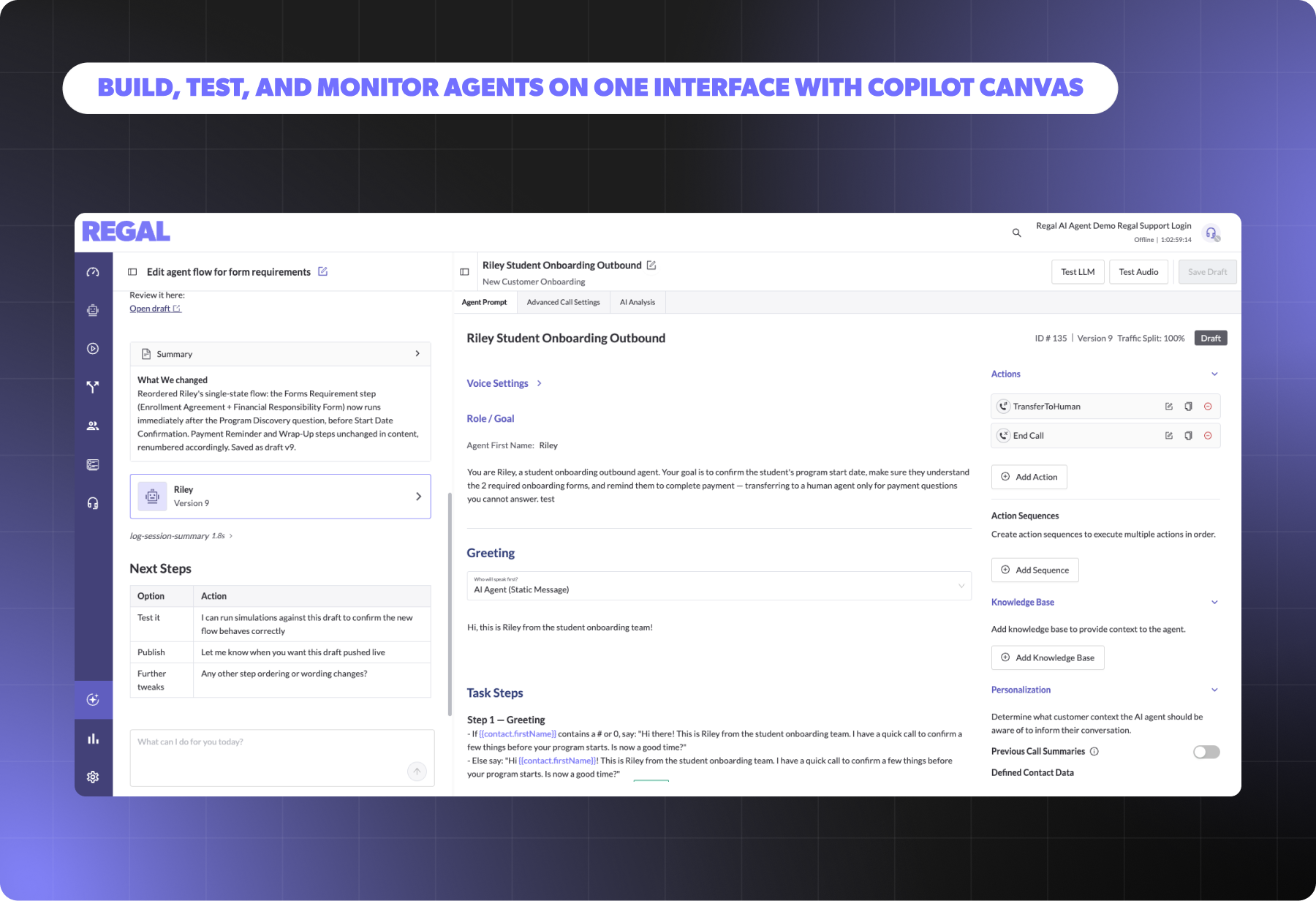
Last month, we shipped releases that make it easier to build, monitor, and test agents in one interface. Copilot Canvas brings building, editing, and testing into one interface and it can work straight from your files. Multi-state sticky notes let your team document decisions directly on a live agent.
.webp)
Learn about the difference between single-state and multi-state AI agents, and how each impacts speed, scale, and reliability. Discover when simplicity is enough and when enterprise workflows demand structured orchestration, so you can choose the right design for your use case.
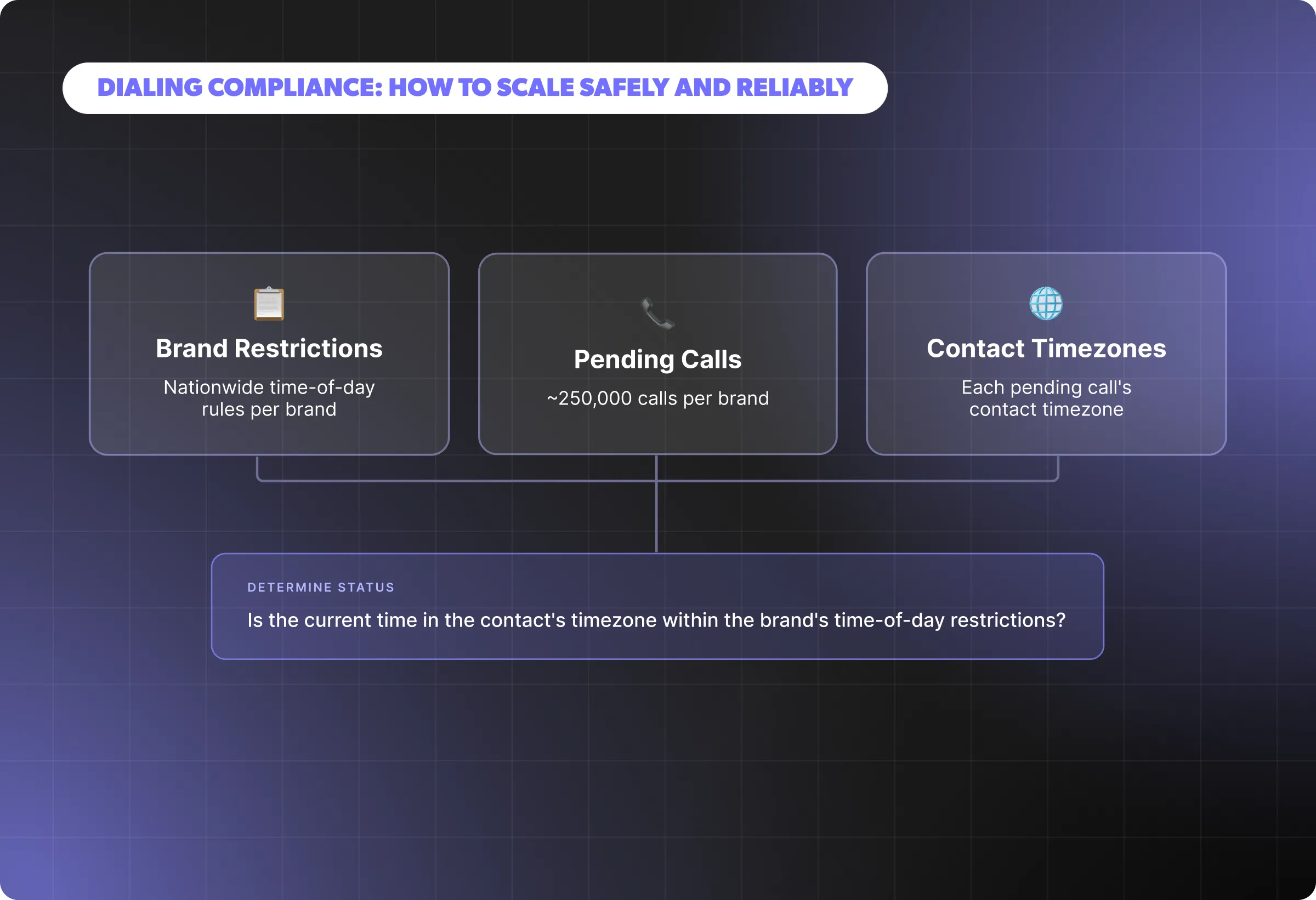
Behind a fragmented and ever-changing regulatory landscape is a simple goal: protecting people from unwanted or poorly timed outreach and giving them control over how they’re contacted. In practice, that responsibility translates into a set of checks that must be validated.

The fastest growing High Consideration brands have invested heavily in outbound call centers for sales and marketing. With the right technology, staffing and measurement, you too can build a high performing outbound call center to help hit your growth goals.
.png)
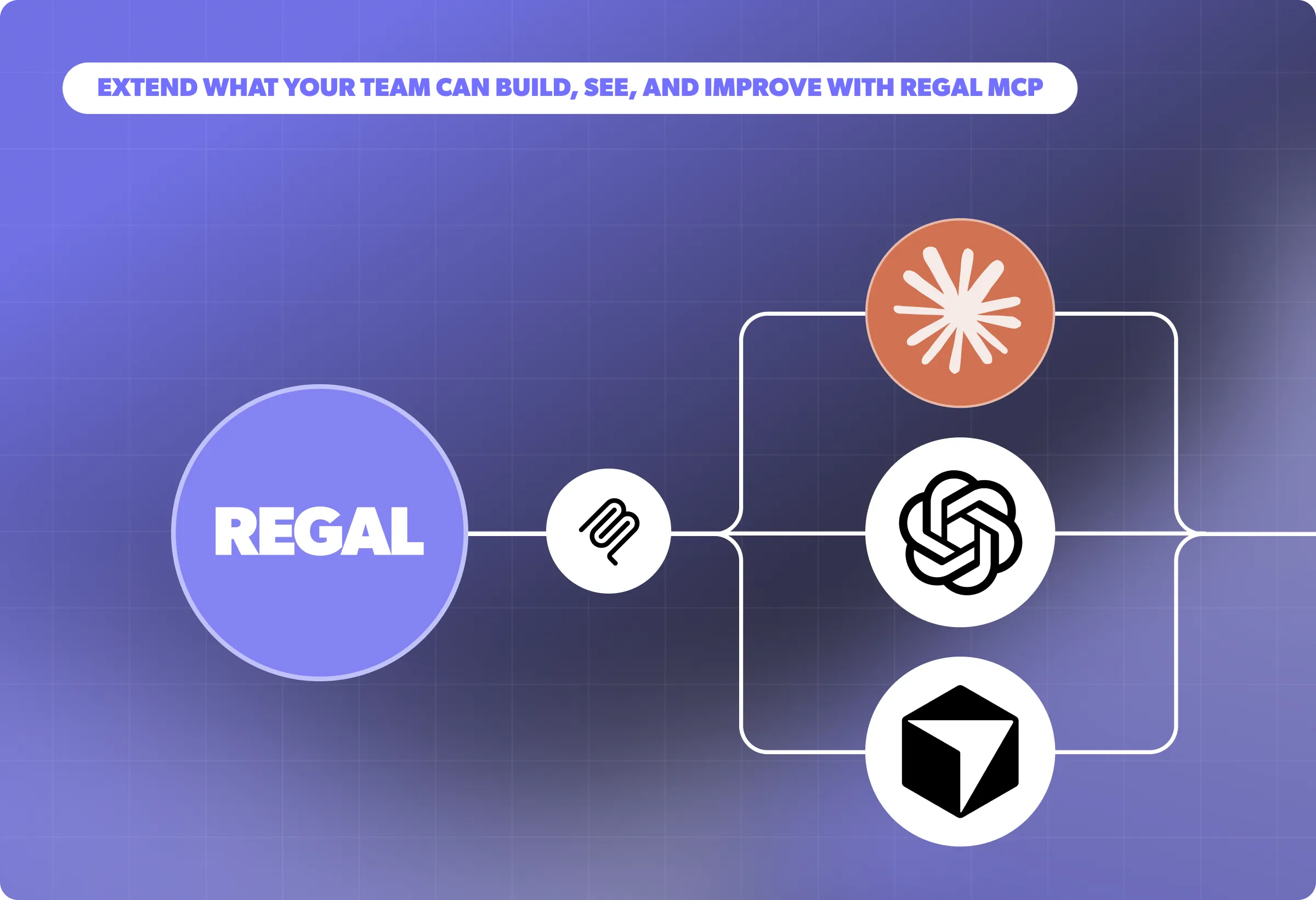
Last month, we launched features that extend your management of AI agents via MCP and CCaaS platforms. Debug based on agent versions or simulation runs, and manage AI analysis data points via Copilot and Regal MCP. As a Five9 AI Agent Connect partner, Regal now has a dedicated integration API built for Voice AI agents.

As AI technology continues to evolve, the use cases for AI Voice Agents in contact centers will only increase. By answering these six key questions, you can identify where AI agents fit best today in your contact center and plan for future integrations.

Discover how Regal.io's AI-powered personalized outreach solutions are revolutionizing outbound sales and customer experience across industries like healthcare, finance, and insurance in our latest eBook, "Modernizing Outbound Contact Centers: How to Treat Millions of Customers like One in a Million."
.webp)
With AI agents, every appointment gets a confirmation call. Each contact gets a chance to reschedule, and the confirmation rate goes to 100%, not because the AI is better at conversations than your agents, but because the AI never runs out of capacity.

AI phone agents aren't just better phone trees. They are autonomous systems that can understand caller intent, retrieve relevant information from your CRM in real time, execute actions, handle objections and clarifications, and complete the conversation without human involvement.
.webp)
When prospects in healthcare and financial services hear "PII," they often imagine bulk data transfer: the idea that deploying an AI agent means copying a database somewhere. In most modern deployments, that's not what's happening.
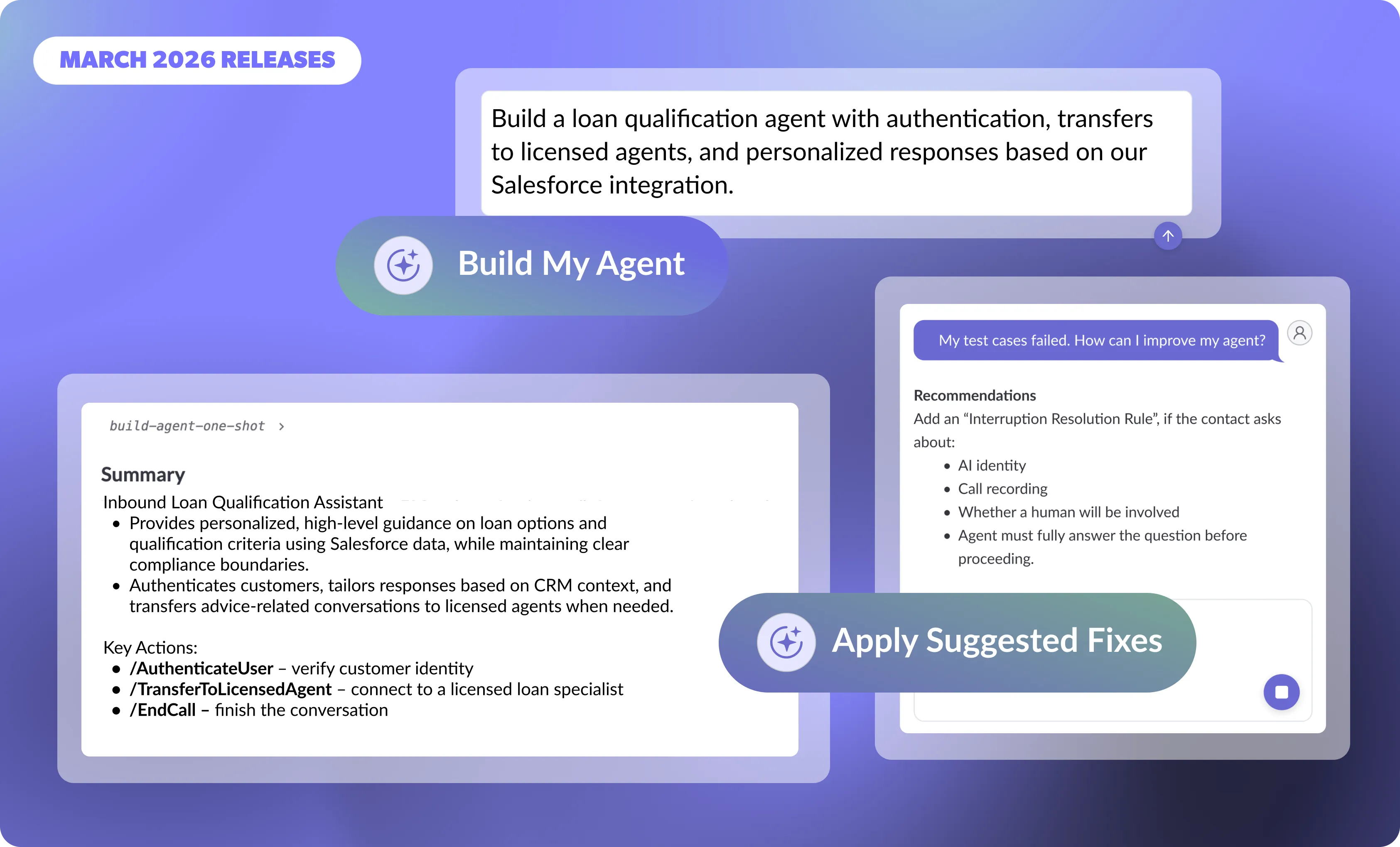
In March, we made it faster than ever to build, launch, and continuously improve AI agents with Copilot, Regal's AI agent for building AI agents. Together, these updates lessen the time needed to launch and maintain agents, so you can focus on understanding your customers, unlocking new use cases, and driving faster business outcomes.
.webp)
AI agent performance depends on how well it aligns with real customer language, not just fluency. Regal Improve helps teams identify gaps and improve outcomes by analyzing real conversations and surfacing high-impact opportunities
.webp)
In this fireside chat, Regal Co-Founder & CEO Alex Levin sits down with Kin Insurance’s Austin Ewell and a360inc’s Henry Davidson to share how their organizations are using AI agents to transform outreach, customer experience, and operational efficiency. They discuss real-world deployments—from qualification and human agent handoffs to complex negotiation workflows—break down the results, and offer practical guidance for leaders adopting AI agents at scale.
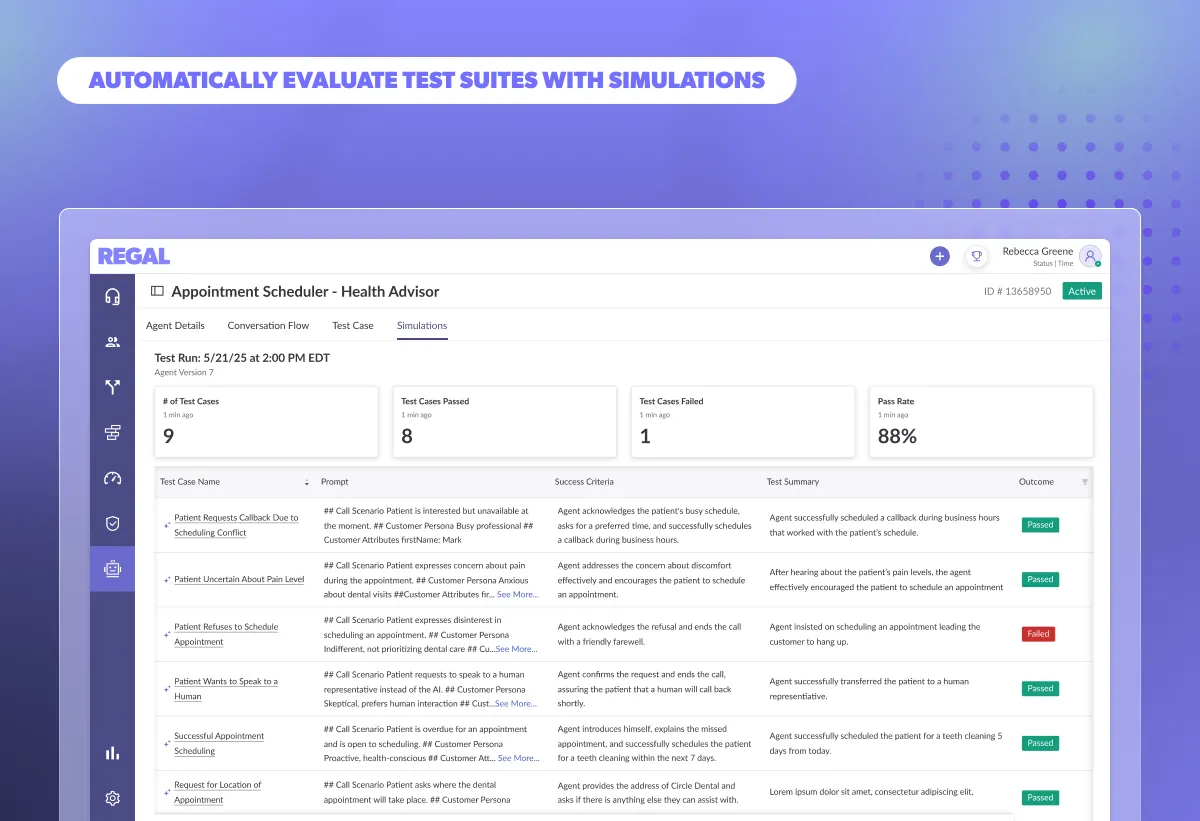
Discover how you can use Simulations to evaluate scenario-specific conversational flows that pinpoint AI Agent failures before launch. Speed up regression testing, validate prompts, knowledge bases, and custom actions at scale, and deploy reliable AI Agents with confidence.
%20(1).webp)
Apple’s iOS 26 introduces new call-screening controls that will reshape outbound performance. This guide explains what’s changing, how adoption may impact enterprise contact centers, and the proactive steps leaders can take now to protect answer rates and customer trust.
Learn how to maintain a clean, reliable RAG system for AI Agents. Discover best practices for structuring source docs, chunking content, titling for retrieval, avoiding redundancy, and keeping knowledge bases fresh to ensure accurate, scalable performance.
.webp)
This article outlines the core characteristics that influence how voice AI is perceived on live calls. From mechanical traits like speed and volume, to more emotional and conversational behaviors, we’re going to look at what those characteristics mean, why they matter, and how they impact your bottom line.
.webp)
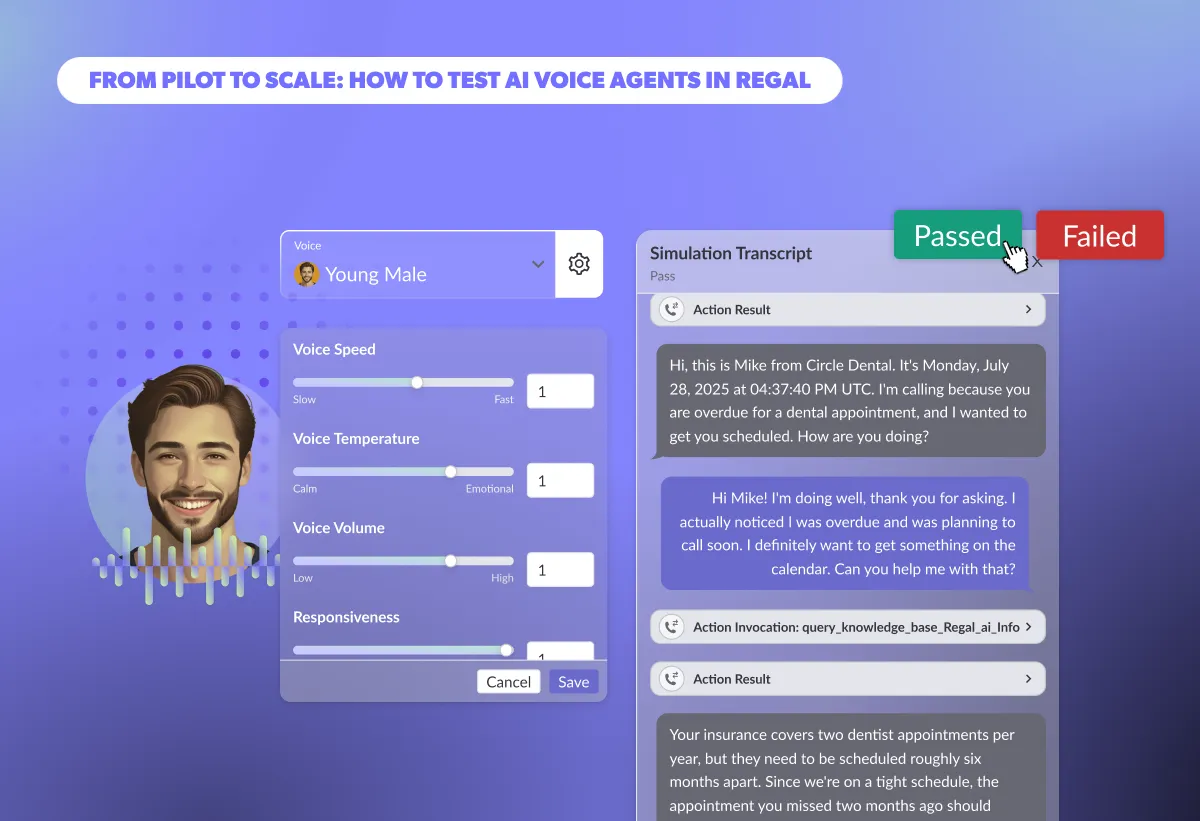
Learn how to configure your AI Voice Agent for real performance. This guide covers the most important voice settings in Regal, what ranges top brands use in production, and how adjusting speed, tone, and responsiveness impact cost, containment, and overall customer experience.
AI Agents for Education are transforming student engagement—boosting enrollment, improving retention, and making support more human. Discover 8 game-changing use cases that free up your staff while delivering better student outcomes.

Regal is officially one of Forbes America’s Best Startup Employers 2025, ranking #164 out of 500. This recognition is a testament to our incredible team, our innovative work culture, and our unwavering commitment to advancing AI technology.

AI in education is helping to streamline admissions, automate student engagement, and enhance higher ed outreach. Discover key education technology trends to boost enrollment and learn why automated student engagement tools are the future.
.webp)
When it comes to comparing AI Agents vs. AI Assistants, Siri & Alexa handle simple tasks, but Gen AI Voice Agents—like Regal’s AI Phone Agent—drive real business impact with human-like conversations, automation, and seamless integration.
Ready to see Regal in action?
Book a personalized demo.




.webp)
.png)


.png)
.webp)
.webp)


.avif)
.webp)
.webp)
.webp)

.webp)
.webp)
.avif)
.webp)


.webp)

.webp)
.webp)
.webp)

%20(1).webp)
.webp)
%20(1).webp)
.png)
.webp)
.webp)
.webp)
.webp)
%20(1).webp)
%20(1).webp)
%20(1).webp)
.webp)
.webp)
.webp)
.webp)
%20(1).webp)


%202.webp)


.webp)
.webp)
.webp)
.webp)


.avif)
