SEPTEMBER 2023 RELEASES
September 2023 Releases
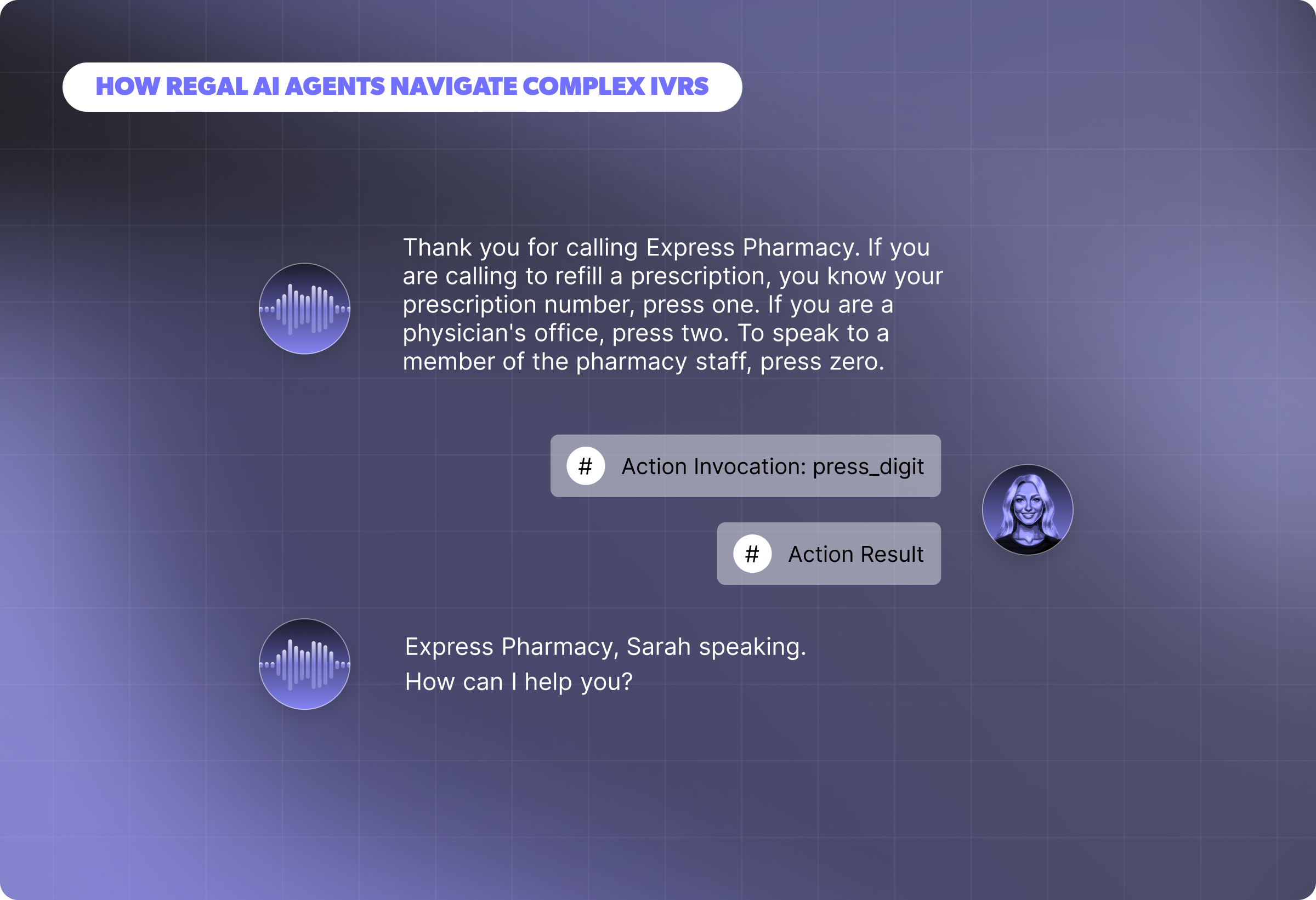
Within the first two seconds of any outbound call, an important classification has to be made: is this a person, a voicemail greeting, an IVR menu, or a call screener? That decision determines whether an AI agent gets deployed on the call at all. Routing an agent to a voicemail wastes money, but failing to identify a human, or even a call screener, costs you the chance to connect with a customer.
That is the operating reality of outbound voice AI within any business. Even with answering machine detection (AMD) running on every call, in high volume outbound campaigns with e.g., 5-10% answer rates, the industry average is that roughly half of the interactions routed to agents are still machines, not people.
That’s because most AI voice agent platforms and CCaaS rely on legacy AMD solutions like Twilio's, or a first-generation fine-tuned model like Bland's, to make that determination. The issue with these solutions is they either let too many answering machines through to AI agents, wasting minutes and reducing the ROI of outbound calling. Or they indiscriminately block call screeners, such as iOS's Call Screening feature, robbing your AI agents of live conversations they would have otherwise won.
With Regal’s next-generation Voicemail Detection model, you can now classify voicemail, iOS or Google call screeners as separate categories with very high accuracy rather than collapsing them into "machines." This categorization is what enables screener-specific handling, ultimately reducing missed agent connections.
.png)
Most AMD products (whether API-based or embedded in your CCaaS) publicly report a single blended “accuracy” number that doesn’t tell the whole story or let customers understand how the model will perform for their specific campaigns. But, not all call campaigns are the same. For example, progressive dialing campaigns have high call volumes of low intent leads, so naturally most responses are machines, not humans.
In that kind of environment, an AMD model can score well on overall accuracy by labeling most calls as “machines”, since the majority of these calls do not connect with humans. This overlabeling can still result in a strong overall accuracy score, even though it is quietly misclassifying humans or call screeners as machines, and dropping calls before a human ever gets a chance to connect.
Regal's Voicemail Detection model is multi-class. It classifies every call into one of five categories:
1. Automated Voicemail
2. Personal Recording
3. Google Screener
4. iOS Call Screener
5. Human Speech
Since Regal's model separates screeners and voicemail as distinct classes rather than collapsing them into "machine," it opens the door to things a binary classifier can't do: screener-specific handling and campaign-level funnel analytics. Additionally it allows us to report accuracy across each of these classes, and continue to train the model -- as inevitably new call screening behaviors, device-native features, and voicemail formats emerge across carriers and operating systems.
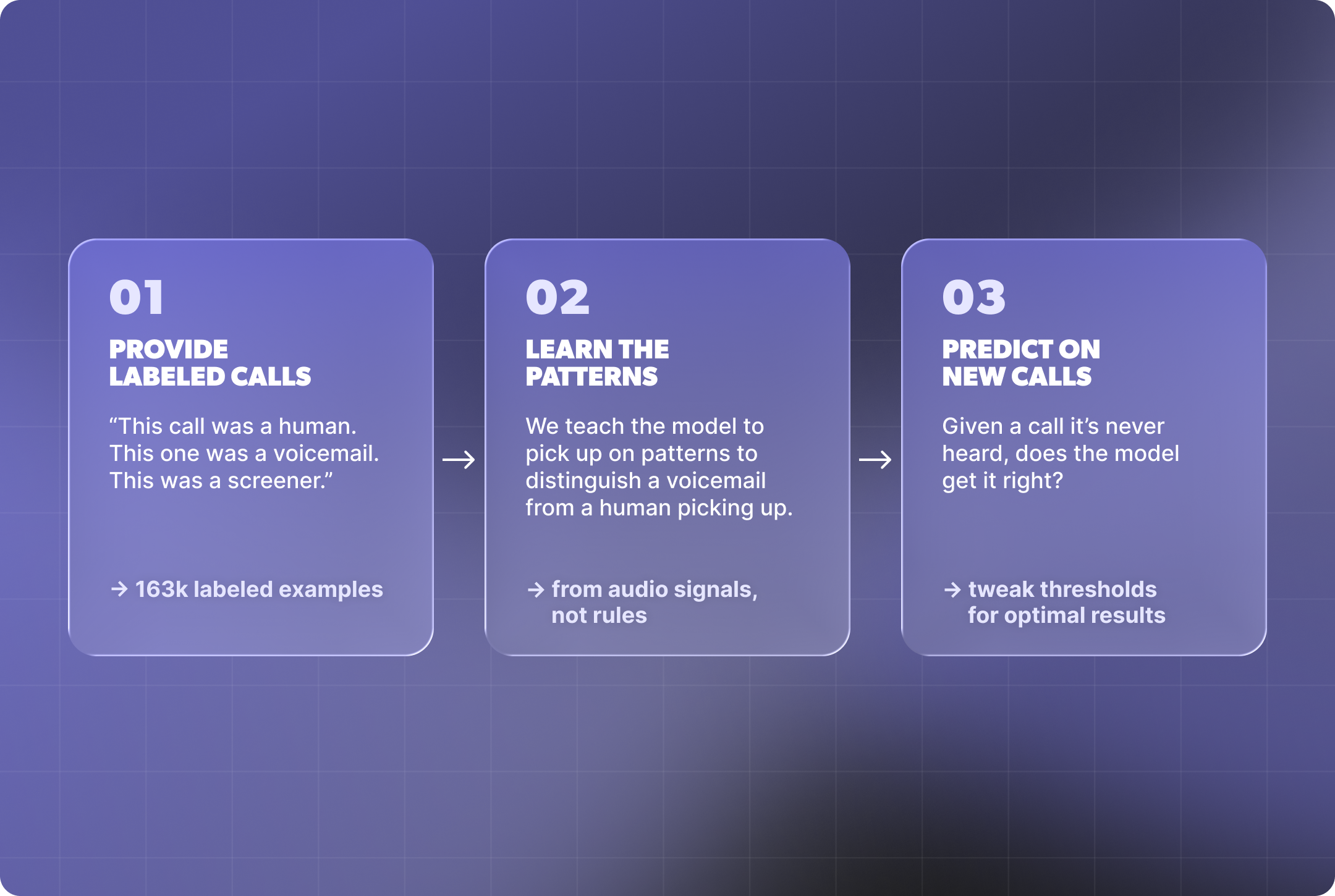
To train our Voicemail Detection model, we started with real outbound call audio from over 163,000 B2C calls and built a labeled dataset using a combination of AI-assisted labeling and manual human review. An LLM assessed transcripts and assigned categories at scale, while our team stepped in to hand-label the roughly 3,000 edge cases that automated labeling handles unreliably such as dead air and short ambiguous fragments.
Before committing to our five-class taxonomy, we ran a clustering analysis on audio embeddings to verify that each class was acoustically distinct, not just conceptually different. This gave us confidence that the model could actually learn to separate them, and highlighted where the boundaries were harder (live speech and personal voicemail greetings, for instance).
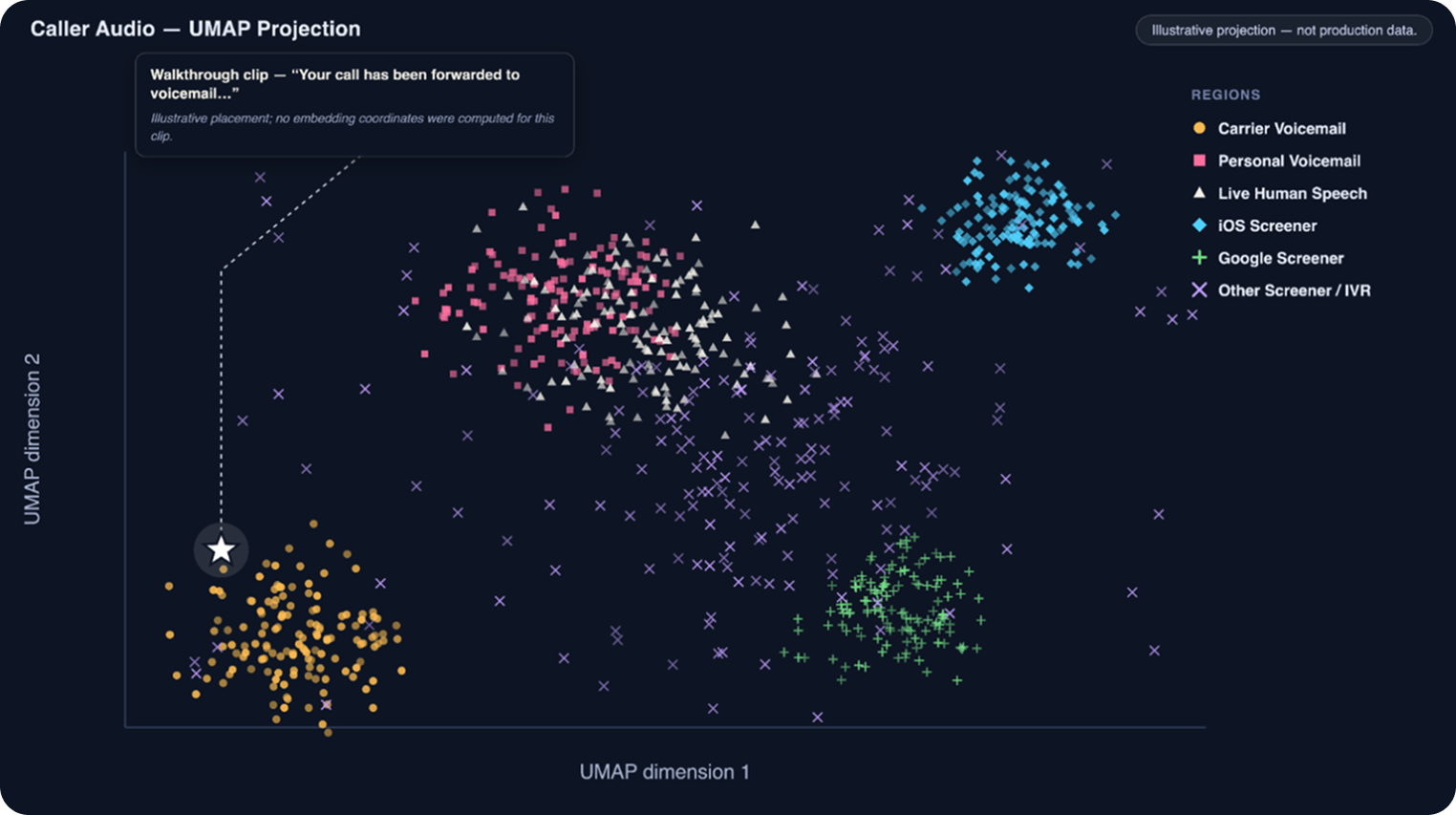
From there, we built on top of WavLM-Base-Plus*, an open-source audio representation model, training custom aggregation and classification layers on its embeddings using 2-second call clips. We tuned the model to prioritize human recall, since missing a real person costs you a conversation, while letting a voicemail through only costs agent minutes.
To evaluate performance, before any training began, we sealed 15% of the labeled data as a held-out test set (constructed to be representative across B2C industries and label distribution), so our accuracy numbers reflect how the model performs on audio it has never seen.
For a closer look at the methodology behind the model and how we’re continuing to evolve it, keep an eye out for an upcoming technical post from our engineering team.
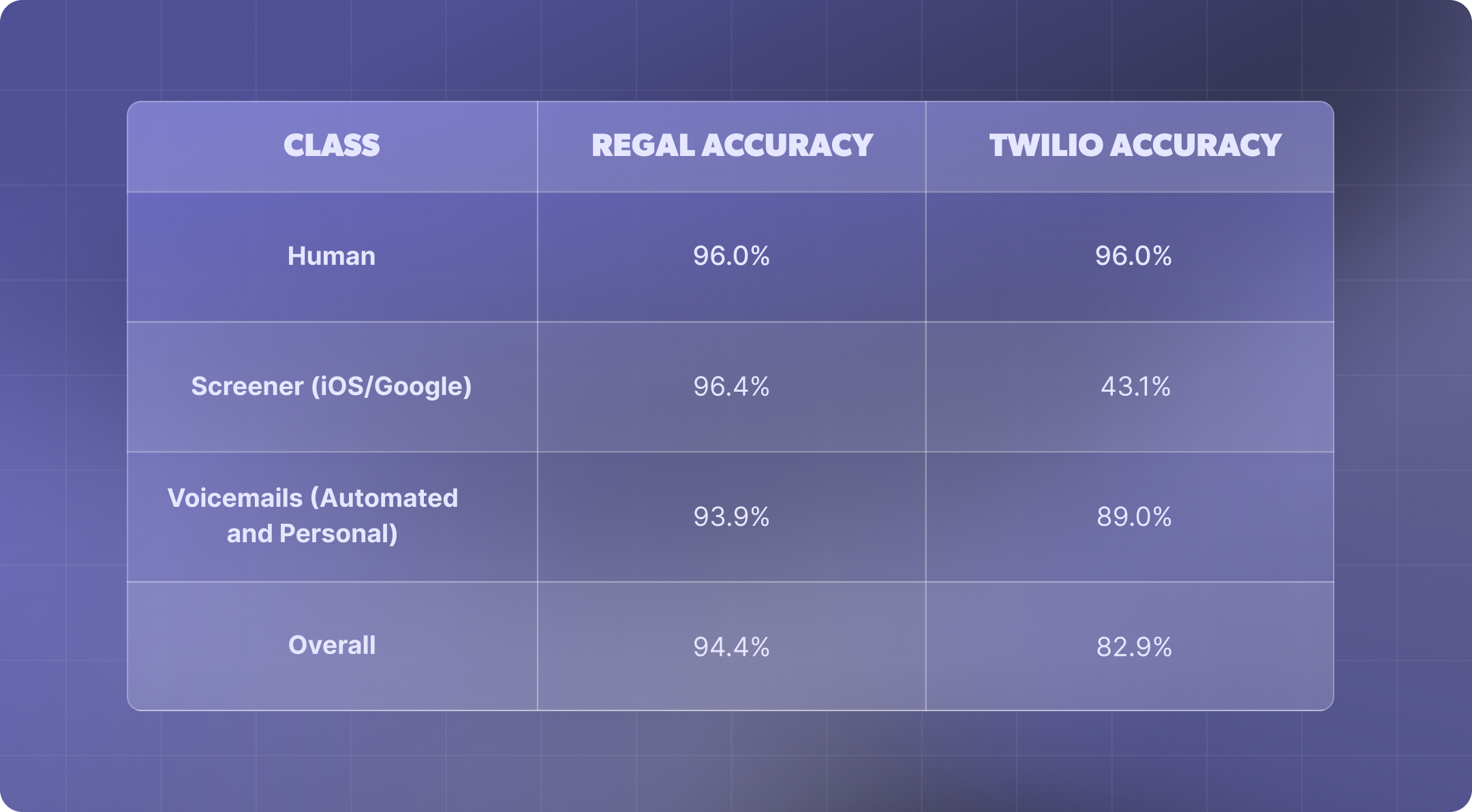
Regal's Voicemail Detection model sends ~45% fewer voicemails to agents compared to incumbent models, directly reducing wasted agent minutes and cost. Of calls we route to an agent, only ~19% turn out to be machines; for Twilio AMD, that number is ~40%.
The gap is even starker on screener classification. Regal detects iOS and Google call screeners with 96% accuracy, while Twilio, at 43%, effectively treats them as machines, hanging up on conversations that could have been won. And we do all of this without sacrificing human recall: both models classify live human speech at ~96% accuracy, so the gains come with no tradeoff on the calls that matter most.
.gif)
Regal's model also makes its determination in 2 seconds, a full second faster than Twilio's minimum 3-second classification.
Taken together, these improvements directly translate to significantly better ROI on outbound AI voice agent campaigns: more live conversations reached, fewer minutes wasted.
_______________________________________________________________________________
*WavLM-Base-Plus by Microsoft (Chen et al., arXiv:2110.13900, 2021), licensed under CC BY-SA 3.0. License: https://github.com/microsoft/UniSpeech/blob/main/LICENSE. Model: https://huggingface.co/microsoft/wavlm-base-plus.
Attribution
REGAL IS NOT A LAW FIRM AND DOES NOT PROVIDE LEGAL SERVICES. DISTRIBUTION OF THIS LICENSE DOES NOT CREATE AN ATTORNEY-CLIENT RELATIONSHIP. REGAL PROVIDES THIS INFORMATION ON AN "AS-IS" BASIS. REGAL MAKES NO WARRANTIES REGARDING THE INFORMATION PROVIDED, AND DISCLAIMS LIABILITY FOR DAMAGES RESULTING FROM ITS USE


.png)
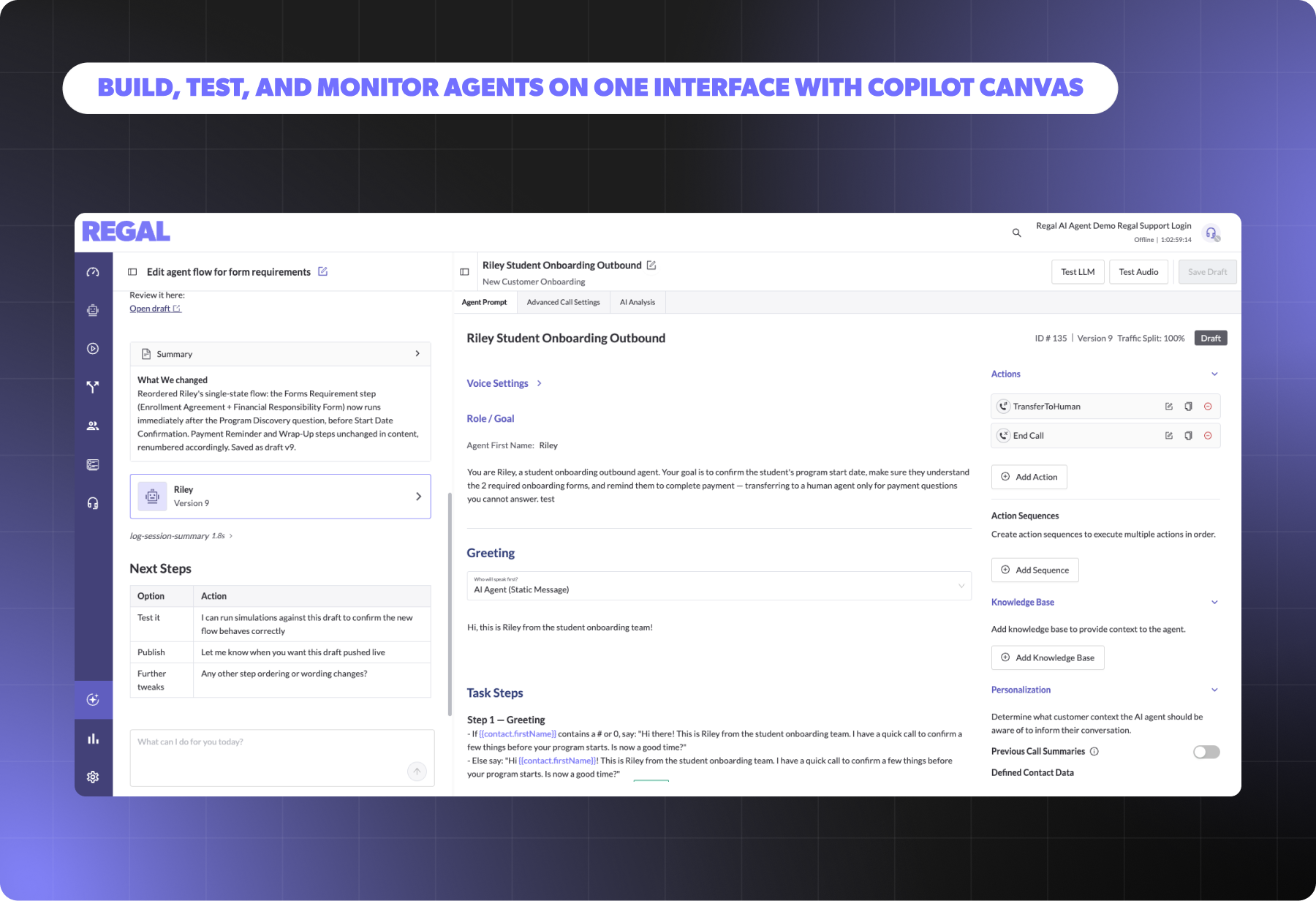
Last month, we shipped releases that make it easier to build, monitor, and test agents in one interface. Copilot Canvas brings building, editing, and testing into one interface and it can work straight from your files. Multi-state sticky notes let your team document decisions directly on a live agent.
.webp)
Learn about the difference between single-state and multi-state AI agents, and how each impacts speed, scale, and reliability. Discover when simplicity is enough and when enterprise workflows demand structured orchestration, so you can choose the right design for your use case.
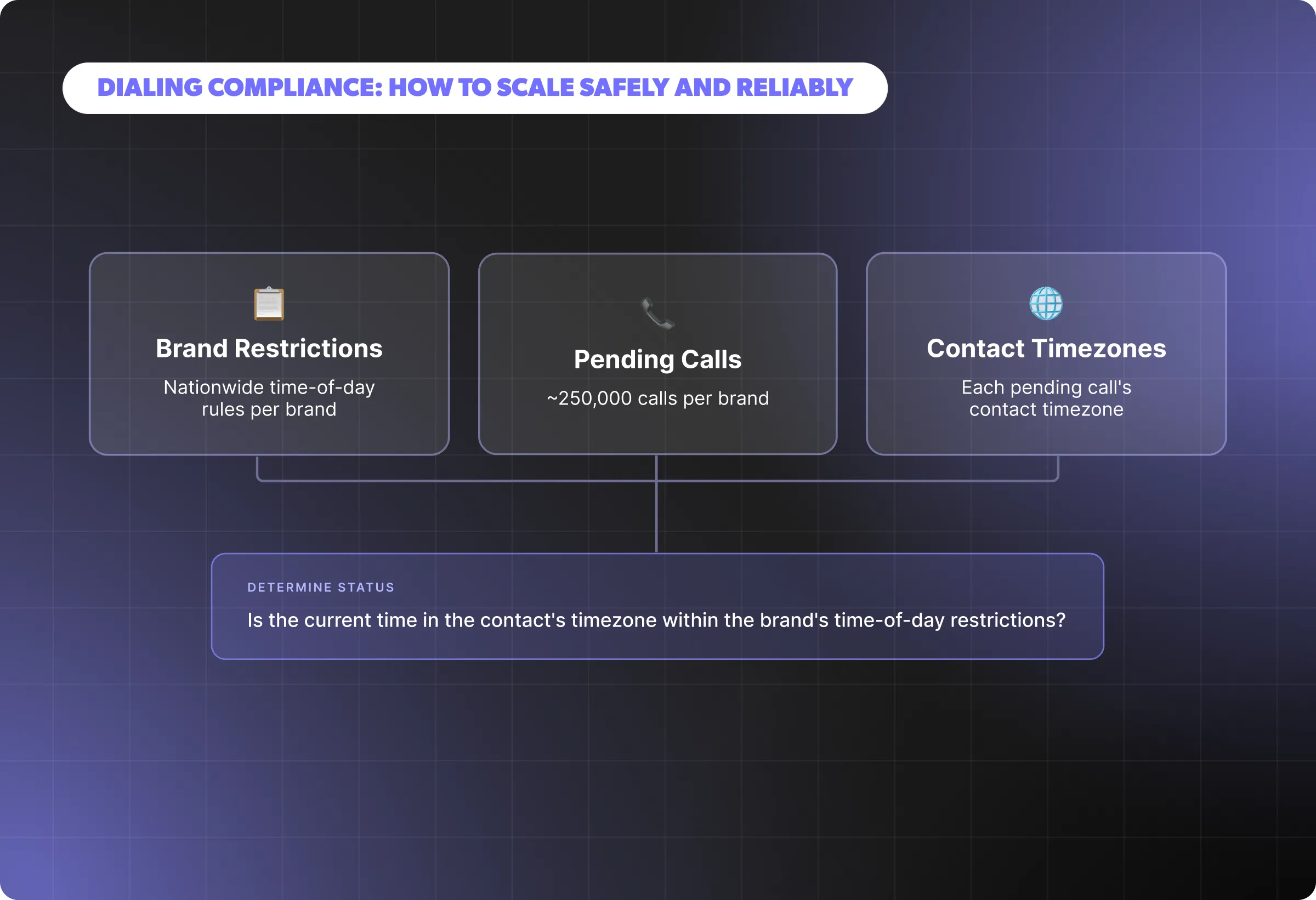
Behind a fragmented and ever-changing regulatory landscape is a simple goal: protecting people from unwanted or poorly timed outreach and giving them control over how they’re contacted. In practice, that responsibility translates into a set of checks that must be validated.

The fastest growing High Consideration brands have invested heavily in outbound call centers for sales and marketing. With the right technology, staffing and measurement, you too can build a high performing outbound call center to help hit your growth goals.
.png)
Last month, we launched features that extend your management of AI agents via MCP and CCaaS platforms. Debug based on agent versions or simulation runs, and manage AI analysis data points via Copilot and Regal MCP. As a Five9 AI Agent Connect partner, Regal now has a dedicated integration API built for Voice AI agents.

As AI technology continues to evolve, the use cases for AI Voice Agents in contact centers will only increase. By answering these six key questions, you can identify where AI agents fit best today in your contact center and plan for future integrations.

Discover how Regal.io's AI-powered personalized outreach solutions are revolutionizing outbound sales and customer experience across industries like healthcare, finance, and insurance in our latest eBook, "Modernizing Outbound Contact Centers: How to Treat Millions of Customers like One in a Million."
.webp)
With AI agents, every appointment gets a confirmation call. Each contact gets a chance to reschedule, and the confirmation rate goes to 100%, not because the AI is better at conversations than your agents, but because the AI never runs out of capacity.

AI phone agents aren't just better phone trees. They are autonomous systems that can understand caller intent, retrieve relevant information from your CRM in real time, execute actions, handle objections and clarifications, and complete the conversation without human involvement.
.webp)
When prospects in healthcare and financial services hear "PII," they often imagine bulk data transfer: the idea that deploying an AI agent means copying a database somewhere. In most modern deployments, that's not what's happening.
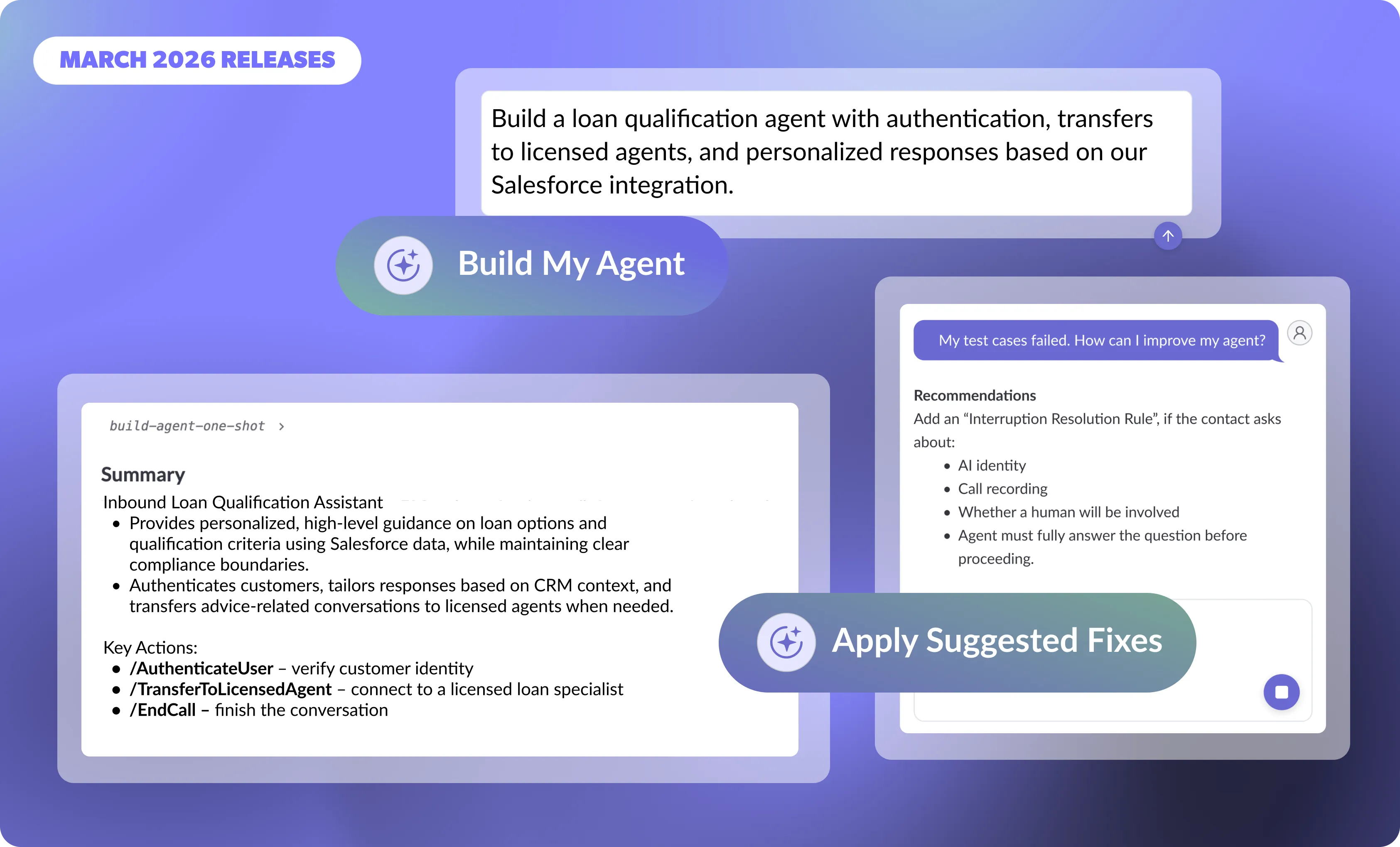
In March, we made it faster than ever to build, launch, and continuously improve AI agents with Copilot, Regal's AI agent for building AI agents. Together, these updates lessen the time needed to launch and maintain agents, so you can focus on understanding your customers, unlocking new use cases, and driving faster business outcomes.
.webp)
AI agent performance depends on how well it aligns with real customer language, not just fluency. Regal Improve helps teams identify gaps and improve outcomes by analyzing real conversations and surfacing high-impact opportunities
.webp)
In this fireside chat, Regal Co-Founder & CEO Alex Levin sits down with Kin Insurance’s Austin Ewell and a360inc’s Henry Davidson to share how their organizations are using AI agents to transform outreach, customer experience, and operational efficiency. They discuss real-world deployments—from qualification and human agent handoffs to complex negotiation workflows—break down the results, and offer practical guidance for leaders adopting AI agents at scale.
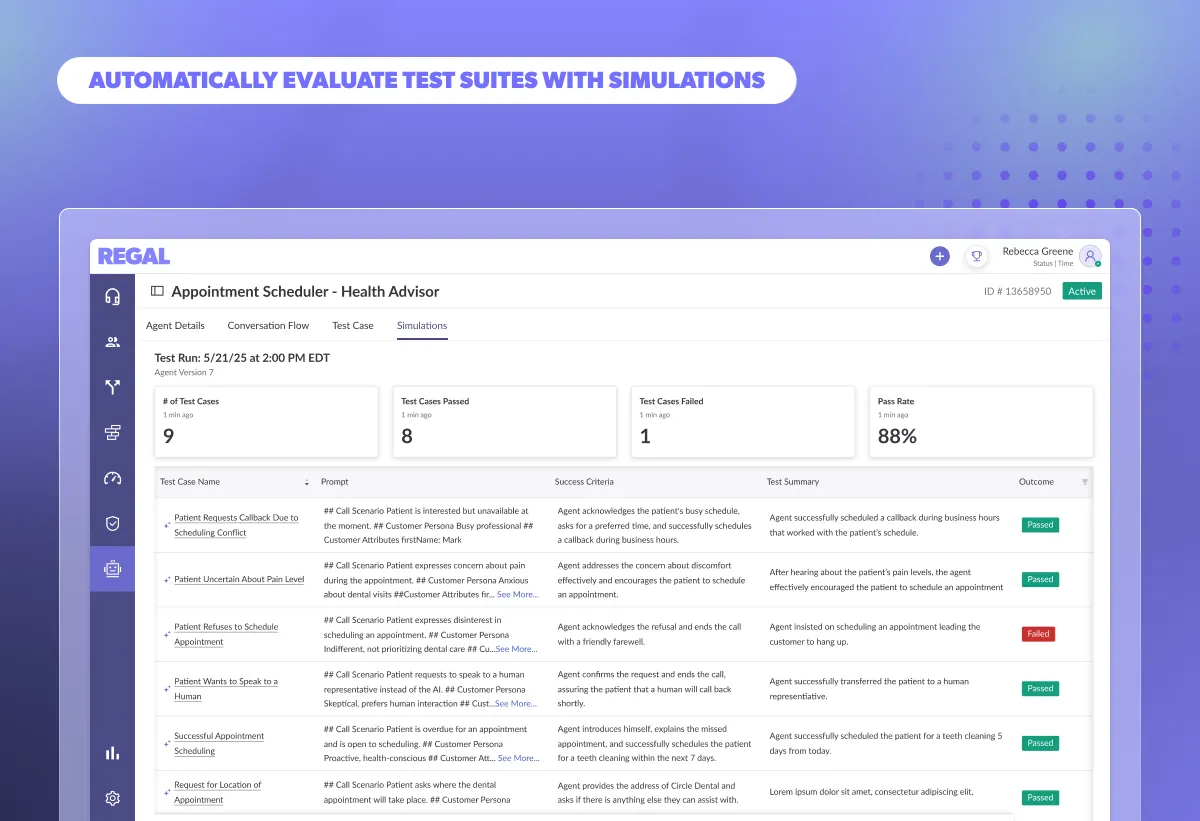
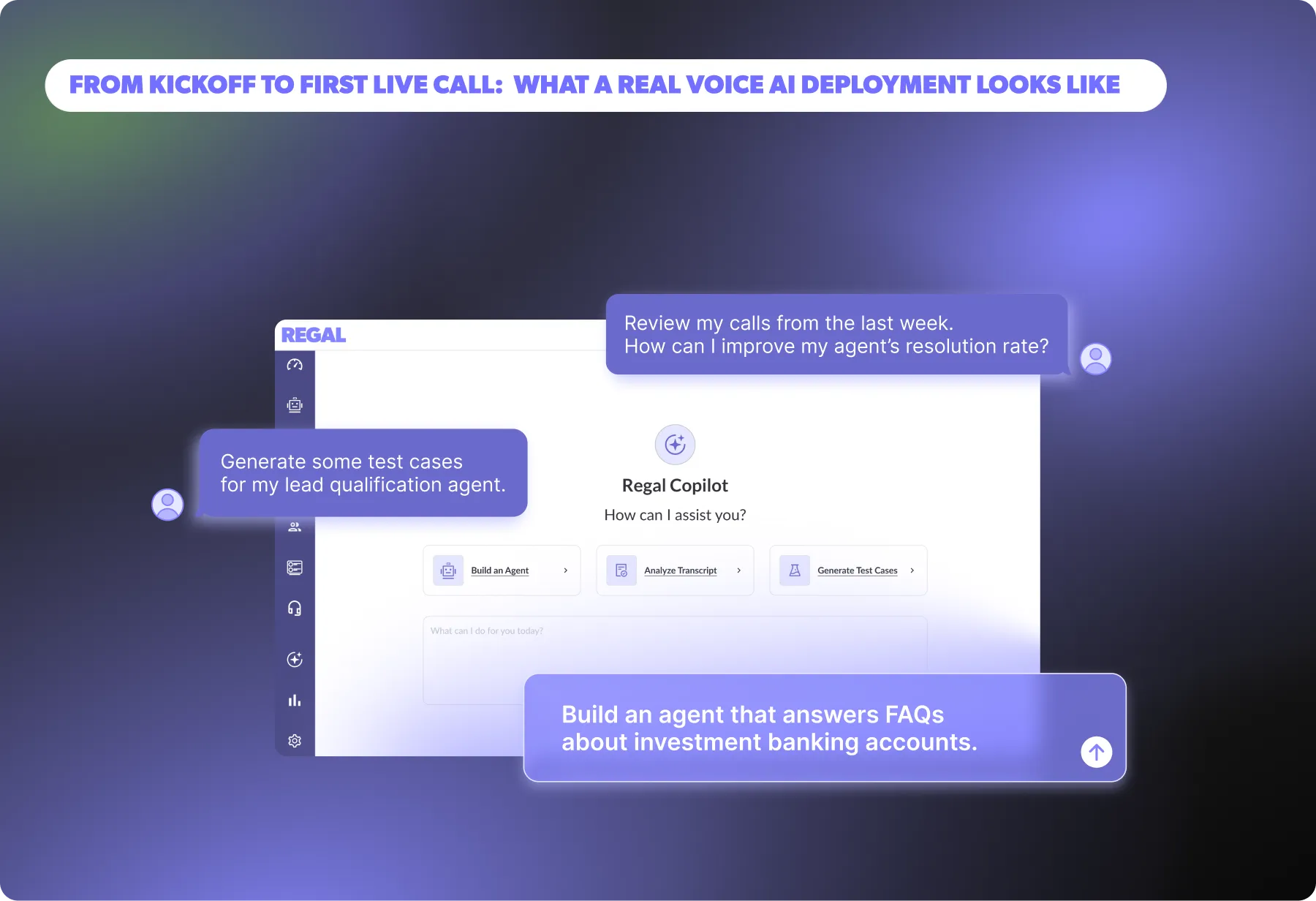
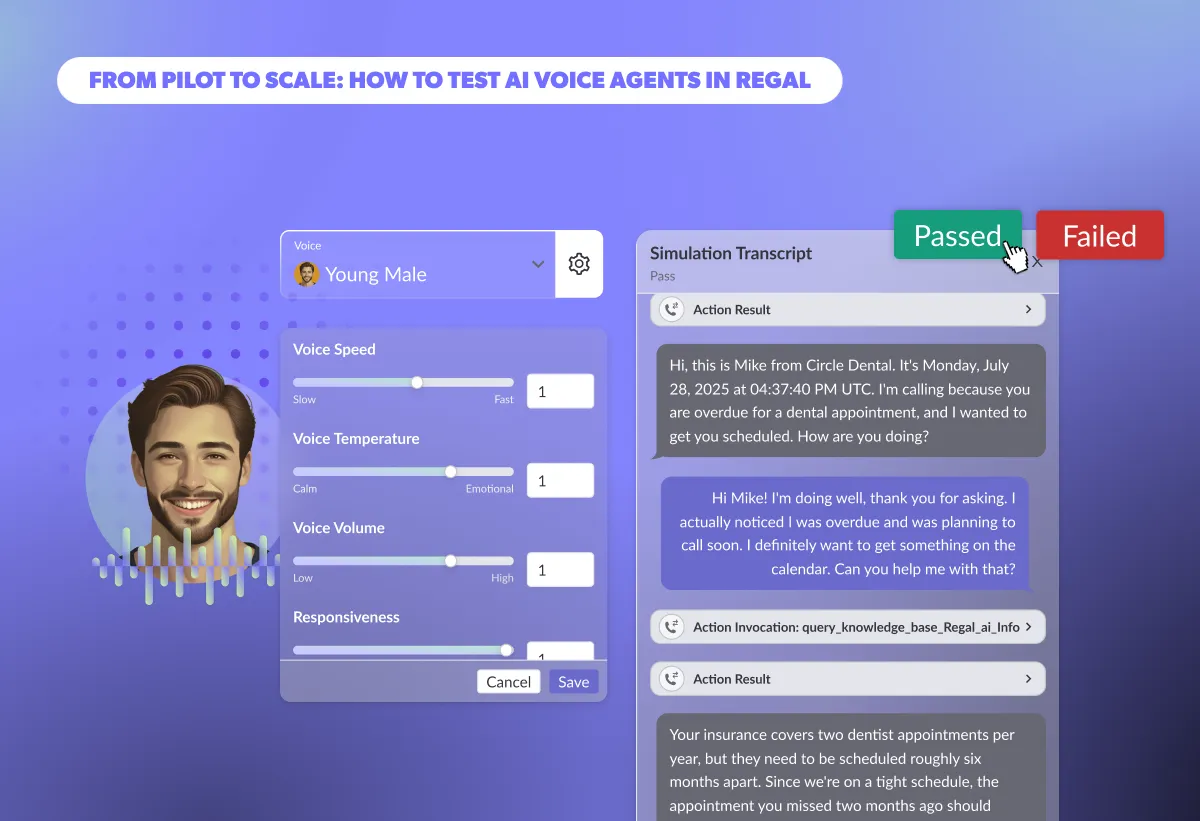
Discover how you can use Simulations to evaluate scenario-specific conversational flows that pinpoint AI Agent failures before launch. Speed up regression testing, validate prompts, knowledge bases, and custom actions at scale, and deploy reliable AI Agents with confidence.
%20(1).webp)
Apple’s iOS 26 introduces new call-screening controls that will reshape outbound performance. This guide explains what’s changing, how adoption may impact enterprise contact centers, and the proactive steps leaders can take now to protect answer rates and customer trust.
Learn how to maintain a clean, reliable RAG system for AI Agents. Discover best practices for structuring source docs, chunking content, titling for retrieval, avoiding redundancy, and keeping knowledge bases fresh to ensure accurate, scalable performance.
.webp)
This article outlines the core characteristics that influence how voice AI is perceived on live calls. From mechanical traits like speed and volume, to more emotional and conversational behaviors, we’re going to look at what those characteristics mean, why they matter, and how they impact your bottom line.
.webp)
Learn how to configure your AI Voice Agent for real performance. This guide covers the most important voice settings in Regal, what ranges top brands use in production, and how adjusting speed, tone, and responsiveness impact cost, containment, and overall customer experience.
AI Agents for Education are transforming student engagement—boosting enrollment, improving retention, and making support more human. Discover 8 game-changing use cases that free up your staff while delivering better student outcomes.

Regal is officially one of Forbes America’s Best Startup Employers 2025, ranking #164 out of 500. This recognition is a testament to our incredible team, our innovative work culture, and our unwavering commitment to advancing AI technology.

AI in education is helping to streamline admissions, automate student engagement, and enhance higher ed outreach. Discover key education technology trends to boost enrollment and learn why automated student engagement tools are the future.
.webp)
When it comes to comparing AI Agents vs. AI Assistants, Siri & Alexa handle simple tasks, but Gen AI Voice Agents—like Regal’s AI Phone Agent—drive real business impact with human-like conversations, automation, and seamless integration.
Ready to see Regal in action?
Book a personalized demo.




.webp)
.png)


.png)
.webp)
.webp)


.avif)
.webp)

.webp)
.webp)

.webp)
.webp)
.avif)
.webp)


.webp)

.webp)
.webp)
.webp)

%20(1).webp)
.webp)
%20(1).webp)
.png)
.webp)
.webp)
.webp)
.webp)
%20(1).webp)
%20(1).webp)
%20(1).webp)
.webp)
.webp)
.webp)
.webp)
%20(1).webp)


%202.webp)


.webp)
.webp)
.webp)
.webp)


.avif)

